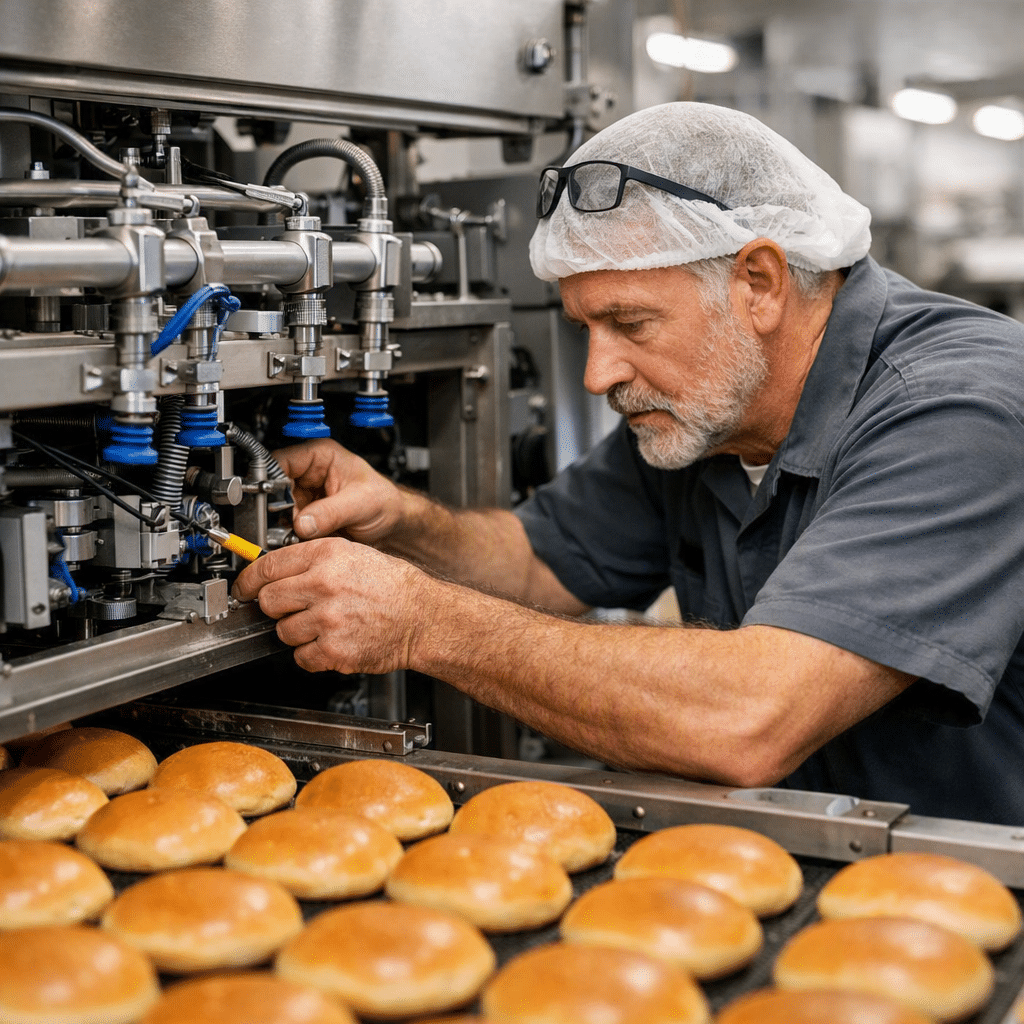
Commercial depanner repair protects the promise your bakery makes to a private-label partner. A retail chain, a foodservice distributor, or a grocery program specifies what your product must look like and how consistent it must remain across every batch. The depanner touches your product last before it moves to packaging, so its condition sets the outcome of that promise on every run. When the equipment stays in good condition, your product meets the specifications your customer expects.
This guide walks through the parts of your private-label agreement that depend on the depanner condition. We cover product appearance, batch consistency, compliance with metal detection requirements, and audit documentation. Each section shows how a well-kept depanner supports your contract terms. By the end, you will see why service and record-keeping carry as much weight as the bake itself.
Commercial Depanner Repair and Your Private-Label Contract
Commercial depanner repair keeps your equipment ready to meet the terms in a private-label agreement. Your customer sets tolerances for appearance, size, and contamination control, and these tolerances are checked on every shipment. A depanner in strong condition supports all of these terms simultaneously. When service stays current, your product continues to meet the contract’s requirements.
Plant teams often focus on formulation when a specification issue appears. Equipment condition plays an equal part in the outcome, and the depanner sits at a key point in that chain. A structured service plan gives your team a clear picture of the equipment’s status. This article introduces four areas where depanner condition and contract terms meet.
Product Appearance Standards and Cup Condition
Private-label customers write down what an acceptable surface looks like for their product. Marks, dents, and crust damage sit on the list of features they exclude. A cup with too much pressure for that stage of baking creates these same marks on your product. This shows how a commercial depanner repair program keeps appearance issues away from your shipments.
Cup hardness also plays a part in this outcome. Standard cups suit most products, while soft cups suit delicate or release-sensitive products better. Soft Metal Det (020 00M), Soft Translucent (020 001), and Blue Soft Metal (020 00BL) give you line options for gentler contact. Matching the right cup to the right product keeps your appearance specifications in place.
Batch Consistency and Retainer Alignment
A private-label customer measures how consistent your product stays across a full batch. A retainer holds the cup in the same position on every cycle, and a worn retainer lets that position shift. Small shifts in cup position create small shifts in product size and release across a run. Your customer often sees this pattern in their own receiving data before your internal check does.
The fix for this issue is a full retainer swap across the platen. Replacing only the retainers that look worn leaves mixed wear in place and lets the pattern continue. FBS carries the full retainer range to support a complete swap, including 5/16-inch White 026 000, Metal 026 001, and Blue Metal 026 002, along with 3/8-inch Standard 027 000 and Metal Det 027 00M. This is the standard a commercial depanner repair program should follow for every platen.
Metal Detection Requirements and Full Assembly Care
Most retail and foodservice private-label agreements set a metal detection standard for product-contact equipment. Depanner cups and retainers fall into that category, so both parts need a detectable design on stations that run private-label products. Pairing a detectable cup with a retainer that carries no detectable design leaves the assembly outside the full standard. Commercial depanner repair keeps every part of the assembly matched to what your agreement asks for.
A complete match includes detectable cups such as Metal Det 019 00M, Blue Metal Det 019 00BL, Soft Metal Det 020 00M, and Blue Soft Metal 020 00BL, paired with Metal Retainer 026 001, Blue Metal Retainer 026 002, or Metal Det Retainer 027 00M. This pairing keeps your station ready for a supplier audit at any time. A ready station supports your account team when a customer asks for proof of compliance.
Audit Documentation and Service Records
A private-label audit often asks for service records tied to your depanner, including cup history, service dates, and proof of detectable parts. A facility that services the depanner only after a failure has gaps in this record that show up during the audit. These gaps generate findings on their own, independent of actual product quality. Clear records give your team a strong answer when a customer asks for proof.
A structured service plan builds this record for you over time. Station-level cup specifications, service dates, and replacement logs come together into a file your team can hand over at any point. Certified technicians create these records for each service call. Commercial depanner repair on a set schedule gives your audit file the depth it needs.
Protecting Your Contract with Commercial Depanner Repair
A full-service plan for commercial depanner repair covers appearance, consistency, detectable parts, and documentation together. Each area supports a different part of your private-label agreement, and all four work as one system. Keeping this system in strong condition protects your budget from the cost of a specification failure, a corrective action, or a hard conversation with your customer. Strong equipment condition keeps that conversation from happening.
FBS provides commercial depanner repair and certified on-site service for bakeries that run private-label products. Our team brings a full cup and retainer range, detectable parts, and complete service documentation to every visit. Call +1 (201) 437 0221 to set up a service plan built around what your customer asks for. Your team gets a clear plan, and your contract gets the protection it needs.
Frequently Asked Questions
What is a commercial depanner, and why does service matter for private-label production?
A depanner is the equipment that lifts baked products from the pan before they move to packaging. Its condition sets the appearance, size, and release quality of every piece that follows. Regular service keeps this step consistent across every run, keeping your product within the standard your customer set.
How often should a depanner get service for private-label production?
The right interval depends on run volume, product type, and the terms in your customer agreement. A certified technician’s visit provides your team with a station-specific service plan based on actual usage. This plan tells you whether your equipment needs attention ahead of a general fixed schedule.
Can worn depanner cups cause product appearance complaints from a private-label customer?
Yes, a worn or incorrect cup applies too much pressure for the product to absorb at that stage, which creates marks and surface damage. These marks match the defects most private-label appearance standards list as excluded. A cup service check catches this before it reaches your customer.
Does retainer wear affect product consistency across a batch?
Yes, a worn retainer allows the cup to shift slightly in position with each cycle, which creates small changes in product size and release. A private-label customer often picks up this pattern through their own receiving checks. A full retainer swap across the platen removes this variation.
Are metal-detectable cups and retainers required for private-label agreements?
Most retail and foodservice private-label agreements set a metal-detection standard for equipment that comes into contact with the product. Depanner cups and retainers fall inside that standard, so both parts need a detectable design on stations running private-label product. This keeps your station ready for a supplier check at any time.
What happens during a supplier audit of depanner equipment?
An auditor often asks for service records, cup specifications by station, and proof that parts carry detectable design. A facility with clear records shows whether its program meets the standard right away. A facility without these records faces a corrective action request.
What service records should a bakery keep for depanner maintenance?
A strong file includes service dates, cup and retainer specifications by station, and replacement logs. Certified technicians generate these records during each visit. This file gives your team a ready answer during a customer audit.
Should worn retainers be replaced one at a time or across the whole platen?
A full platen swap gives the most reliable result. Replacing single retainers as they wear leaves mixed wear across the platen, and this keeps the consistency issue in place. A complete swap brings every station back to the same standard at once.
How does regular depanner service support a private-label contract?
A full service plan covers cup condition, retainer alignment, detectable parts, and documentation. Each part supports a different term in your private-label agreement. Strong service keeps your product within spec and keeps your contract protected over time.