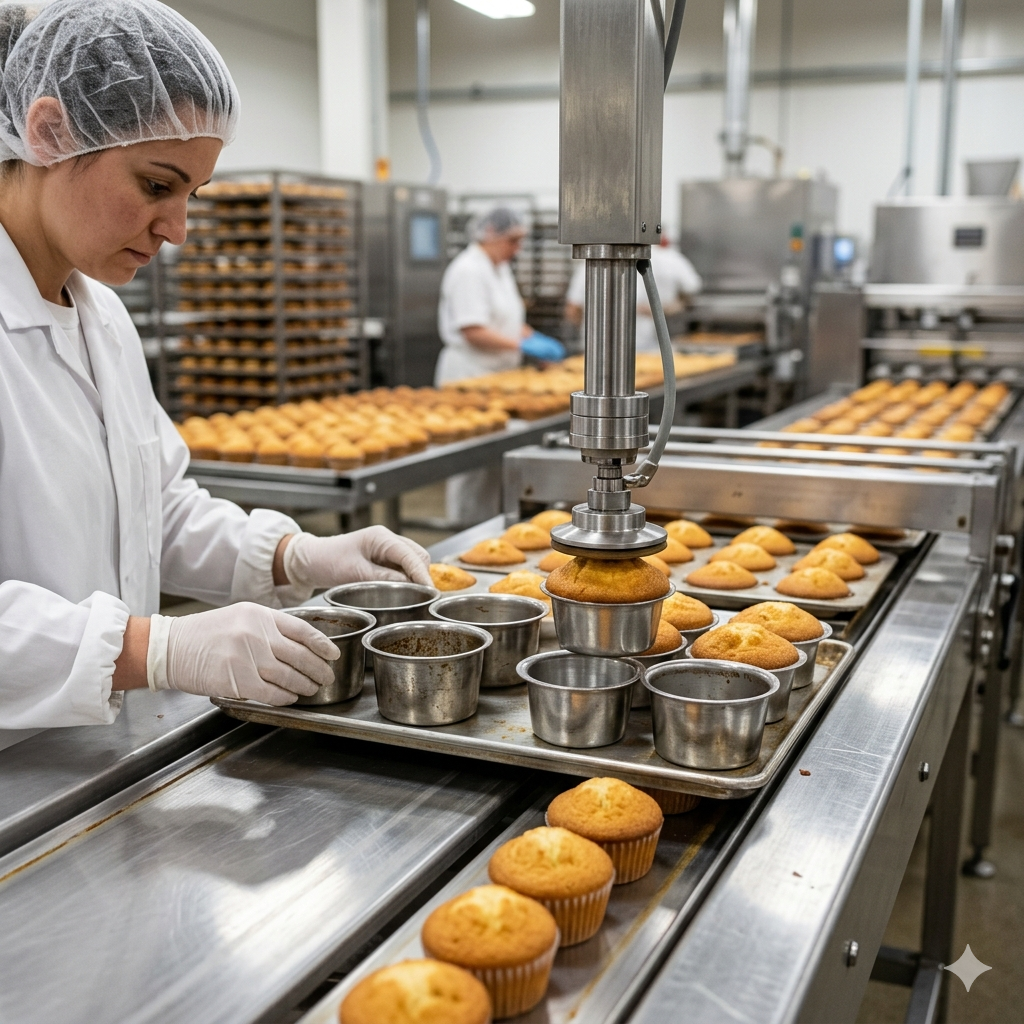
Ordering the wrong depanner cups for sale can lead to costly line stoppages. Ensuring the correct specifications, like hardness and profile, helps you feel confident in your choices and keeps your operation running smoothly. This guide walks through the four variables that determine the right cup for your operation.
The Hardness Variable: Standard vs. Soft Cups
Cup hardness determines how the cup contacts the product at the moment of depanning. Standard formulation cups, including the Metal Detectable (019-00M), Blue Metal Detectable (019-00BL), Translucent (020-000), and Red Cup (021-000), are suited for lines where consistent vacuum hold and firm structural contact are the priority. These work well on products that are firm enough after baking to withstand a firmer grip without surface deformation.
Soft formulation cups, including the Blue Soft Metal (020-00BL), Soft Metal Detectable (020-00M), and Soft Translucent (020-001), are designed for more delicate products. The softer material conforms to surface variations across individual loaves or rolls, reducing marking, tearing, and deformation on high-speed lines where mechanical contact consistency is harder to control.
The decision is straightforward. Firm product with reliable vacuum hold as the priority: specify a standard cup. Soft or irregular product surface with cosmetic integrity as a line standard: specify a soft cup.
The Detectability Variable: When Metal Detectable Cups Are Required
Metal detectable depanner cups for sale contain compounded additives that allow them to be identified by inline metal detection equipment. Two compliance scenarios drive this requirement. The first is operations running internal HACCP programs that require full-line foreign object traceability. The second is operations supplying customers whose contracts include metal detection requirements at the supplier level.
FBS offers metal-detectable cups across both hardness formulations. Standard hardness metal detectable options include the Metal Det. (019-00M) and Blue Metal Det. (019-00BL). Soft formulation detectable options include the Soft Metal Det. (020-00M) and Blue Soft Metal (020-00BL). The Red Flat Metal (024-000) extends detectability to flat profile applications.
The blue variants carry an additional operational advantage. The color serves as a visual identifier on the line floor, reducing substitution errors when multiple cup types are used across different platens or lines.
Retainer detectability matters equally. FBS carries the Metal Retainer (026-001) and Blue Metal Retainer (026-002) for operations that require detectability across the full cup and retainer assembly. A metal-detectable cup paired with a standard white retainer may create a compliance gap. Confirm this with your quality or HACCP team before specifying.
The Profile Variable: Domed Cups vs. Flat Cups
The cup profile determines how the cup geometry aligns with the product geometry. A mismatch produces an uneven or incomplete vacuum seal, which leads to misfeeds, drops, or inconsistent depanning across the platen.
Domed cups are the standard geometry for most bread-and-roll depanning applications. The curved profile seats against the crown of a round or oval loaf, creating a consistent seal across the contact surface. Most of the FBS catalog, including standard, soft, and metal detectable variants, uses this domed geometry.
Flat cups, the Clear Flat (022-000), Red Flat (023-000), and Red Flat Metal (024-000) are specified for products with a flatter top profile. A domed cup on a flat product makes uneven contact and weakens the seal. Flat cups are also used in applications where platen height or angle geometry requires a lower-profile cup to maintain consistent contact across the full platen.
Check the existing cup profile before ordering because verifying whether it is convex (domed) or level (flat) helps ensure compatibility and prevents misfits on the line.
Retainers: The Spec Detail Most Buyers Overlook
Retainers are the clips that secure the cup to the depanner platen post. They are ordered separately, sized to the post, and ordering the wrong inner diameter means the cup will not seat, regardless of how accurate the cup specification is.
FBS carries retainers in two inner diameter sizes.
5/16″ ID retainers include the White Retainer (026-000), Metal Retainer (026-001), and Blue Metal Retainer (026-002).
3/8″ ID retainers include the Standard Retainer (027-000) and Metal Det. Retainer (027-00M).
Measuring the retainer inner diameter or pulling an existing retainer helps you feel in control and avoid compliance gaps. Confirm these details before ordering to ensure your line runs smoothly.
FBS can help you feel assured by offering custom parts to your specifications, ensuring your unique application is supported even if catalog options don’t match your line’s geometry.
Order the Right Spec the First Time
Four variables determine which depanner cups for sale are right for a given operation: hardness, detectability, profile, and retainer inner diameter. A wrong call on any one of them produces the same result: a line stoppage and a parts return that a better ordering decision would have prevented.
FBS carries the full range across all four variables, including custom parts made to specification for non-standard applications. To confirm the correct spec for your line, call (201) 437-0221 before placing the order. It is a faster conversation than a return.
Frequently Asked Questions
What is the difference between soft and standard depanner cups?
Standard depanner cups are formulated for firm, consistent vacuum contact and are suited for products that are structurally firm after baking. Soft depanner cups use a more compliant formulation that conforms to surface irregularities, making them the correct choice for delicate or soft crusted products where a standard cup would cause marking or deformation. Specifying the wrong hardness is one of the most common ordering errors in commercial depanning.
Do depanner cups need to be metal detectable?
Metal detectable depanner cups for sale are required when an operation runs an HACCP program that includes foreign-object traceability, or when supply agreements require metal-detection compliance at the component level. When this requirement applies, both the cup and the retainer must be metal detectable to satisfy a full assembly compliance check. FBS offers metal-detectable options across standard and soft hardness formulations, as well as flat and domed profiles.
When should flat depanner cups be used?
Flat depanner cups are used when the product being depanned has a flat or low-profile top surface, where a domed cup would create uneven contact and break the vacuum seal. They are also specified in applications where the platen geometry requires a lower-profile cup to maintain consistent contact across the full assembly. When current cups are domed, and seal inconsistency is occurring, confirming that the cup profile matches the product profile is the right step before ordering replacements.
What size depanner retainers are needed?
Depanner retainer size is determined by the inner diameter of the depanner’s platen post. FBS carries retainers in 5/16″ ID and 3/8″ ID sizes. Measuring the platen post diameter or removing an existing retainer to check its markings is the right approach before ordering. Ordering the wrong inner diameter means the retainer will not seat on the post, regardless of the cup specified.
What does blue metal detectable mean on a depanner cup?
Blue metal detectable depanner cups for sale carry the same compounded additives as standard metal detectable cups, making them identifiable by inline metal detection equipment. The blue color adds a second layer of identification. Line staff can visually distinguish blue metal-detectable cups from standard or translucent cups on the platen, reducing substitution errors when multiple cup types are used across the same facility.
Can a metal detectable cup be paired with a standard white retainer?
Pairing a metal-detectable cup with a non-detectable white retainer creates a compliance gap in a full-assembly metal-detection program. When an HACCP program or supply agreement requires full assembly detectability, both the cup and the retainer must meet the detectability specification. FBS carries metal-detectable retainers, including the Metal Retainer (026-001) and Blue Metal Retainer (026-002), for operations that require them.
How can worn depanner cups be identified?
The most common indicators of cup wear are vacuum loss, inconsistent product release, surface marking on the product, or visible deformation of the cup contact face. Cup wear is gradual, and performance issues are often attributed to line speed or product variation before cup condition is checked. Inspecting cups on a scheduled cycle is a more reliable approach than waiting for a line failure to prompt replacement.
Are custom depanner cups available for non-standard applications?
FBS manufactures custom depanner cups for sale and retainers to specification for applications where standard catalog dimensions do not match the line geometry. When a depanner uses a non-standard platen post diameter or requires a cup profile outside the standard catalog, contacting FBS at (201) 437-0221 to discuss custom part options is the right step before ordering standard replacements that may not fit.
What is the difference between a 5/16″ and a 3/8″ depanner retainer?
The 5/16″ and 3/8″ measurements refer to the inner diameter of the retainer, which must match the platen post on the specific depanner. Both sizes are available in non-detectable and metal detectable materials through FBS. Confirming the post diameter before ordering avoids a sizing mismatch that prevents the retainer from seating correctly.
Where can depanner cups for commercial bakery lines be purchased?
FBS supplies depanner cups for sale and retainers for commercial bakery operations across a full range of hardness, profile, and detectability specifications. The catalog includes standard, soft, metal detectable, blue metal detectable, domed, and flat cup variants, along with matching retainers in both 5/16″ and 3/8″ inner diameters. Call (201) 437-0221 to confirm the correct spec for your line before placing an order.