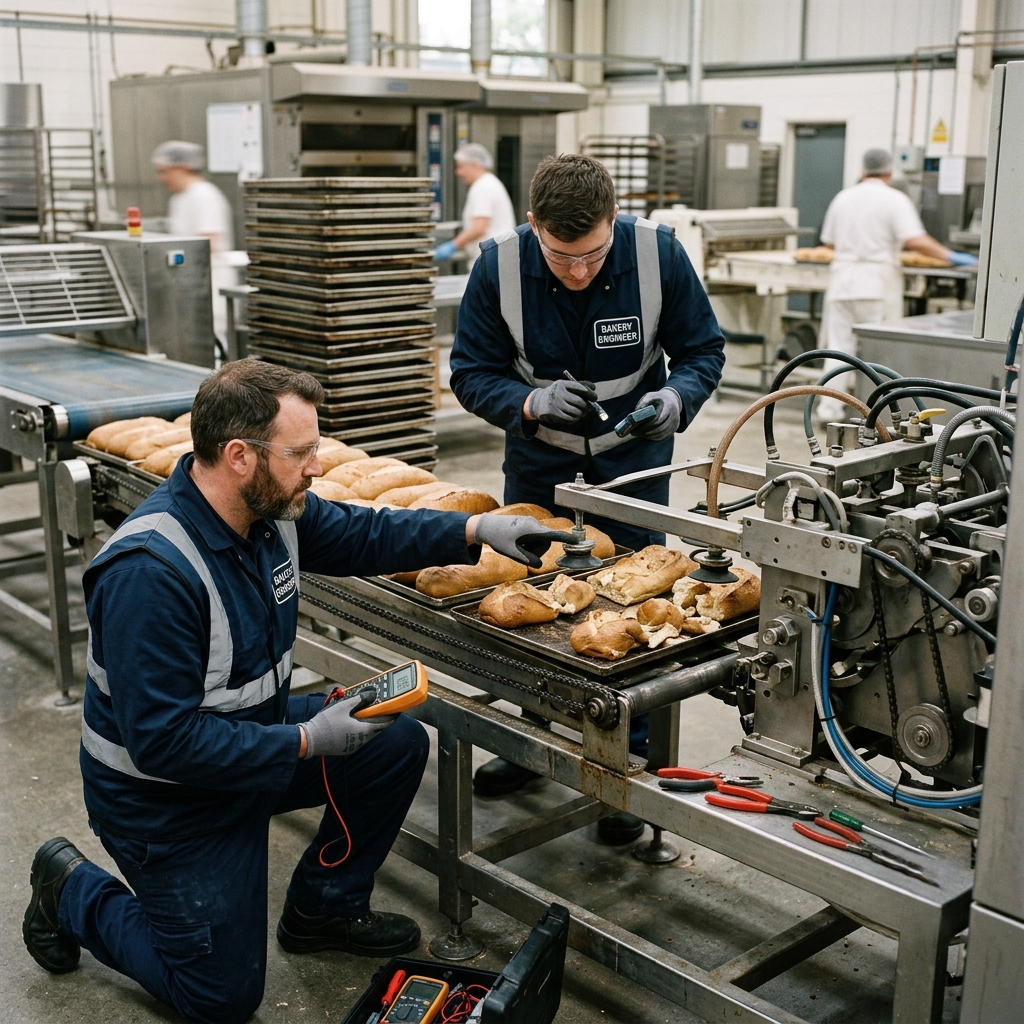
For three months, the damage kept showing up in production reports. The team adjusted hydration, checked oven profiles, and reviewed the pan inventory. Commercial depanner repair is the step that finally points the investigation toward the true mechanical source.
When product damage persists despite every upstream adjustment, the answer often lies downstream, in the system that applies force to the product at its most delicate moment. The depanner is an active force application system. When it sits out of specification, it creates damage that looks like a formula problem.
Why a Commercial Depanner Repair Audit Matters for Bakeries
A commercial depanner repair audit provides quality teams with a clear framework for assessing the mechanical aspects of product damage. Most investigations focus on ingredients and heat, and the depanner gets overlooked as a quality variable.
This audit covers four areas: cup condition, retainer alignment, belt condition, and vacuum pressure. Each area creates its own damage pattern, and each pattern becomes predictable once the mechanical condition is mapped.
Audit Variable One: Cup Condition and Contact Force
Inconsistent cup condition across a platen creates an inconsistent contact force profile. Platen running cups at different wear stages apply different forces to different product positions. Some loaves release cleanly, while loaves beside them take more or less force based on the cup condition at that exact spot.
Soft cup formulations like Soft Metal Det. 020 00M and Soft Translucent 020 001 reduce contact force on delicate products. A hardened soft cup exerts force on the product it cannot absorb, resulting in compression marks and surface tears. A standard cup placed on a soft cup line applies rigid contact where yielding contact is needed.
The audit checks the cup face condition across the full platen and compares the soft cup material against a new cup reference. Commercial depanner repair teams confirm a uniform wear stage across the full cup population.
Audit Variable Two: Retainer Alignment and Lateral Force
Retainer misalignment lets the cup move during contact. This movement creates a lateral force on the product surface, producing tears and marks that get blamed on crust fragility or formula weakness.
A properly seated cup applies vertical force straight onto the product. A cup sitting in a worn or misaligned retainer shifts during the vacuum cycle, adding a sideways or rotational force at the exact point where the product holds tightest to the pan. This creates a mark in a consistent platen position, with severity that changes based on production conditions.
A retainer post diameter mismatch, such as a 5/16-inch retainer on a 3/8-inch post, causes the cup to shift on every run. The audit checks retainer holding security, confirms post diameter against retainer inner diameter, and looks for visible retainer deformation.
Audit Variable Three: Belt Condition and Transfer Damage
Belt condition affects the product at a different point in the cycle compared with cup and retainer contact. Cup and retainer issues create damage during the lift phase. Belt issues create damage during transfer, when the product moves from the pan to the conveyor, and this damage shows up on the underside or at the edges.
A worn belt surface creates uneven friction during transfer. A product that should release smoothly catches or slides, creating compression marks or edge damage at the transfer point. Belt tension plays a role, too: a loose belt sags under product load, and a tight belt adds extra friction at the transfer surface.
Commercial depanner repair audits check belt surface condition across the full width, tension consistency, and transfer geometry under load. This gives the team a clear read on whether belt wear contributes to the damage pattern.
Audit Variable Four: Vacuum Pressure and Internal Damage
Excessive vacuum pressure applied to the product’s structure causes internal damage that remains hidden during production. Bread is at its most vulnerable right after baking, when the crumb has set but not fully firmed. The vacuum force applied at this stage can compress the internal structure before any surface mark appears.
Vacuum pressure that varies across the platen, caused by worn seals or cup inconsistency, applies different internal forces to different product positions. This creates the same kind of pattern seen with cup and retainer issues, where the damage tracks platen position and reads as process variation. Residue on the cup face changes the seal geometry, adding another layer of pressure inconsistency.
The audit checks vacuum pressure consistency across the platen during operation and reviews the cup face condition for residue buildup. A full commercial depanner repair audit brings all four variables together for one clear picture.
Resolving the Investigation with Commercial Depanner Repair
A full audit covering cup condition, retainer alignment, belt condition, and vacuum pressure gives the investigation a clear direction. Once the audit finds the mechanical source, the fix becomes simple to plan and schedule.
FBS carries the full range of cup types, retainer variants, and belt components needed for the correction. Scheduling a commercial depanner repair audit before the next production run protects product quality and reduces waste. Call +1 (201) 437-0221 to schedule a certified technician visit.
Frequently Asked Questions
How does cup condition affect bread depanning?
Cups at different wear stages apply different forces across the platen. Some products release cleanly while others nearby take more or less force, creating a damage pattern tied to cup position.
Can retainer misalignment cause surface tears on bread?
Yes, a cup sitting in a worn or misaligned retainer shifts during the vacuum cycle, applying sideways force to the product. This creates tear marks at a consistent platen position.
Can a belt condition cause damage during bread transfer?
Yes, a worn or improperly tensioned belt creates uneven friction during the transfer from pan to conveyor. This produces edge damage or surface marks separate from cup or retainer damage.
Can vacuum pressure cause internal bread damage?
Yes, vacuum force applied too strongly at the depanning stage can compress the crumb structure internally. This shows up later as texture inconsistency or structural weakness during handling.
What happens when product damage continues after recipe adjustments?
Once hydration, proofing, and oven settings have been checked, the damage source is likely in the mechanical system. A commercial depanner repair audit gives the team a clear path forward.
What does a commercial depanner repair audit check?
The audit reviews cup condition, retainer alignment, belt condition, and vacuum pressure consistency. These four areas cover most of the damage patterns mistaken for formula issues.
Why does damage appear on some batches and skip others?
Mechanical wear spreads unevenly across a platen, whether through cup wear, retainer fit, or seal condition. This creates damage tied to specific platen positions.
How often should a bakery schedule a depanner audit?
A bakery seeing repeated, unexplained product damage after ruling out recipe causes benefits from scheduling an audit soon. Waiting for a routine maintenance cycle can prolong the issue.
What does FBS include in a commercial depanner repair audit?
FBS technicians review all four mechanical variables and carry a full range of cups, retainers, and belt parts. This gives the bakery a complete path from audit to correction in one visit.