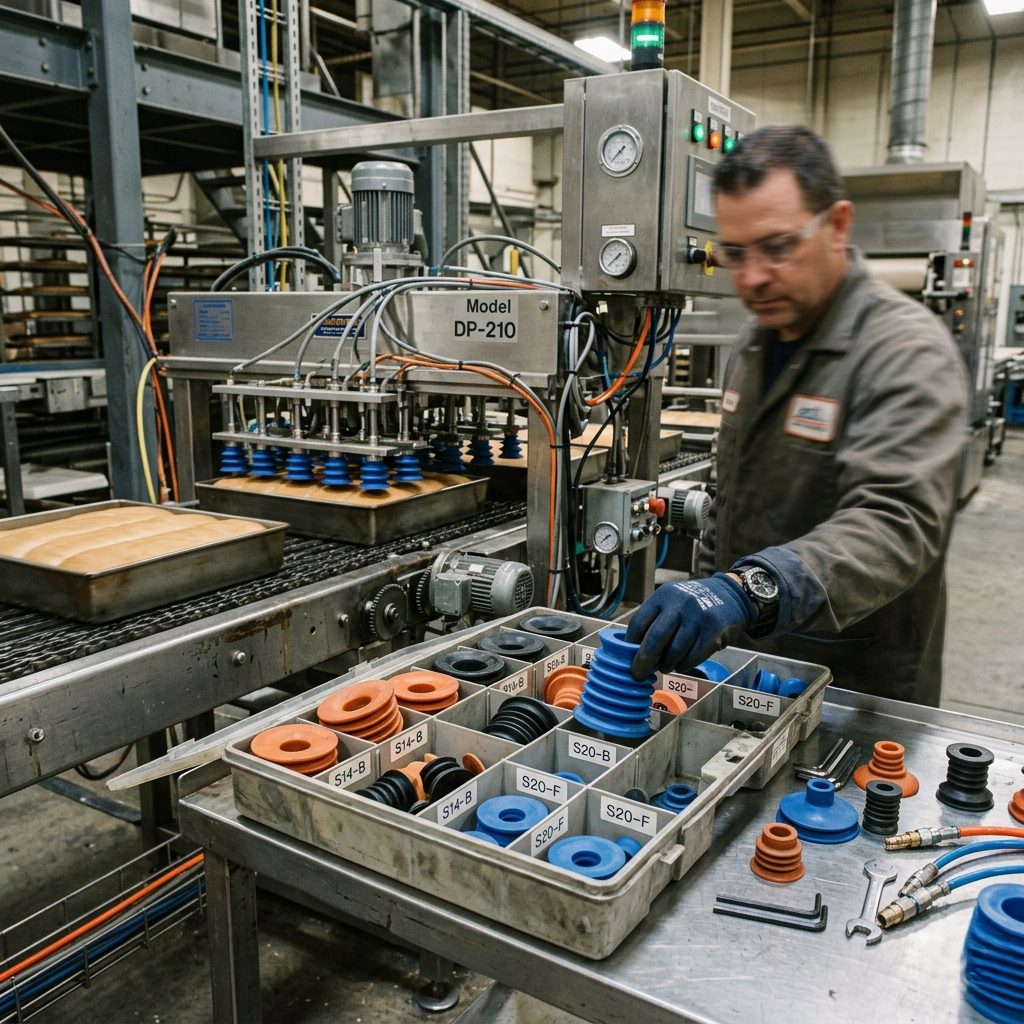
The cost of a wrong decision to replace depanner cups rarely shows up as a single line item. It spreads quietly across waste reports, maintenance logs, compliance findings, and emergency parts orders throughout the year. This article identifies four specific cost events tied to cup type selection and how confirming the right specification closes all of them.
Cost Event One: Product Damage from Wrong Cup Hardness
Wrong cup hardness is the most direct path from a depanner cup replacement specification error to a measurable production cost. The cost appears in waste and rework reporting, away from the maintenance budget where the specification decision lives. This creates a visibility gap that keeps the root cause unaddressed.
The mechanism is straightforward. Standard cup formulations maintain a firmer contact geometry suited to structurally robust products. On softer products like delicate rolls, enriched doughs, and products with fragile crust structure, the contact force exceeds what the product can absorb without surface marking, tearing, or deformation on release.
The cost signature shows up as an inconsistent release, surface marking that fails quality inspection, and increased operator intervention. These events are recorded as waste or rework in production reporting. They are visible as quality problems, and the connection to the original cup specification goes unexamined.
The Correct Specification for Soft Products
Soft cup formulations, including Soft Metal Det. 020-00M, Soft Translucent 020-001, and Blue Soft Metal 020-00BL are designed to accommodate product surface variations and reduce contact force on delicate products. Running the correct soft cup on a soft-product line eliminates the specification-driven damage events. The improvement in the waste line traces back to the specification correction.
Cost Event Two: Accelerated Replacement Cycles from Specification Mismatch
A depanner cup replacement running outside its design specification wears faster. The shortened bakery replacement cycle gets absorbed as maintenance spend without being identified as a specification problem. The pattern repeats cycle after cycle with the cause remaining unexamined.
Soft cups are designed to perform through compliance. Material flexibility is a functional property. When soft cups are exposed to heat or to cleaning chemicals outside their design range, the material hardens progressively, and a hardened soft cup no longer performs its designed function, even when it has no visible cracks.
Standard cups on stations that require soft-cup performance create a similar problem from the other direction. The harder material applies force that the product cannot absorb, creating surface contact stress that accelerates wear at the contact face. Replacement intervals shorten over successive cycles, and the pattern is attributed to heavy use.
Stabilizing Replacement Cycles with the Right Cup Type
Cups running within their design specification wear at their intended rate. FBS carries a full soft and standard cup range to support correct specification across all station types. Replacement cycles stabilize once the specification is confirmed. Maintenance spend returns to its planned baseline.
Cost Event Three: Compliance Exposure from Wrong Detectability Designation
The cost of a single HACCP audit finding for a non-detectable cup at a metal-detection-required station is far higher than for a standard cup. The compliance event is entirely preventable through correct specification. Choosing the right type of depanner cup replacement at this station is a compliance decision.
Stations operating within a metal detection program require a complete detectable assembly, meaning a detectable cup and a detectable retainer. A non-detectable cup, such as standard Translucent 020-000, Red Cup 021-000, or Clear Flat 022-000, running on a detection-required station creates a HACCP gap. A fragment from a non-detectable component passes through undetected, and the gap stays invisible until an audit surfaces it.
The cost structure is asymmetric. Correct specification, including Metal Det. 019-00M, Blue Metal Det. 019-00BL, and Soft Metal Det. 020-00M, costs incrementally more per unit. A single compliance event generates audit findings, potential product holds, and supply chain consequences with major commercial bakery customers at a cost far above a year of correctly specified cups.
The Visual Identification Advantage of Blue Detectable Variants
Blue detectable variants, including 019-00BL, 020-00BL, and 026-002, add a visual identification layer that reduces substitution errors on the line. A blue cup is visually distinct from a standard cup, making a misspecification visible before it becomes a HACCP gap. This makes the blue designation a specification choice with a direct compliance cost implication.
Cost Event Four: Sourcing Premium from Repeated Specification Correction
The sourcing premium from ordering the wrong depanner cups replacement type, discovering it underperforms, and then sourcing the correct specification under production pressure is paid multiple times per year at facilities without a documented cup specification per station. Two orders are placed where one planned order should have been. The correction order carries an emergency sourcing premium that the original planned order would have avoided.
The mechanism begins with the absence of a documented specification. Without a confirmed cup type by name and SKU, the retainer inner diameter, and a detectable or non-detectable designation for each station, replacement orders default to what is available or to what was last ordered. When the substitute specification underperforms, the correct specification must be sourced as a correction under pressure.
FBS stocks all 10 cup types and all 5 retainer variants across an 8,000-part inventory, available for planned replenishment orders at standard pricing. One correctly specified planned order costs less than two reactive orders and eliminates the production disruption between them. Documenting the specification for each station and maintaining it with a reliable supplier permanently closes this cost event.
Confirming Your Specification Before the Next Order
The four cost events covered here, including product damage, accelerated replacement cycles, compliance exposure, and sourcing premium, all trace back to the same root cause. A depanner cup replacement type was selected without confirming it was correct for the station, the product, and the compliance requirement. Confirming the correct specification before the next replacement cycle closes all four cost events at once.
FBS carries all types and sizes of depanner cups replacement parts and can confirm the correct specification for every station before an order is placed. Call +1 (201) 437-0221.
Frequently Asked Questions
What happens when the wrong hardness depanner cup is used on a soft product?
A standard hardness cup applies more contact force on release. These events appear in production reporting as waste or rework, and the connection to cup specification is rarely made. Switching to the correct soft cup formulation eliminates the damage at the source.
Why do depanner cups wear out faster when the wrong type is used?
Cups that run outside their design specification exhibit abnormal wear patterns, shortening replacement intervals. Soft cups that have hardened due to heat exposure bear load as rigid contacts. Standard cups on soft-product lines wear faster at the contact face.
What is the compliance risk of using non-detectable depanner cups on metal detection lines?
Stations in a metal detection program require fully detectable assemblies that cover both the cup and the retainer. A non-detectable cup at a detection-required station creates a HACCP gap, allowing fragments to pass through the detection system undetected. This gap generates audit findings and potential product holds at a cost far greater than the price difference between standard and detectable cups.
What does a HACCP compliance failure due to the wrong depanner cups cost?
The cost structure is asymmetric. Detectable cups cost incrementally more per unit. A single compliance event, including audit findings, product holds, and supply chain consequences with major commercial bakery customers, can generate costs that exceed a full year of correctly specified cups many times over.
How does ordering the wrong depanner cups create repeat sourcing costs?
Facilities without a documented station-level specification default to ordering whatever is available, and when that substitute underperforms, a correction order is placed under production pressure. That correction order carries expedited shipping costs and above-standard pricing. One planned order placed with the correct specification avoids all those added costs.
What should a bakery document for each depanner cup station?
A complete station-level specification includes the cup type by name and SKU, the retainer inner diameter, and the detectable/non-detectable designation. This documented specification enables planned replenishment orders at standard pricing and ensures compliance requirements are built into the ordering process. It also eliminates the substitute-and-correct sourcing cycle that adds cost throughout the year.
What is the difference between soft and standard depanner cups?
Soft cups perform through material compliance, conforming to product surface variation and reducing contact force on delicate products. Standard cups maintain a firmer contact geometry suited to structurally robust products. Running the wrong hardness in either direction creates performance problems, accelerated wear, and potentially product damage that would not occur with the correct specification.
How can a bakery confirm the correct depanner cup specification for each station?
The most reliable approach is confirming the specification with a supplier who stocks the full range and can identify the correct cup type, retainer size, and detectability designation for each station. FBS carries all 10 depanner cup types and 5 retainer variants and can confirm the correct depanner cup replacement specification by station before any order is placed. Call +1 (201) 437-0221 to confirm the specification before the next order.