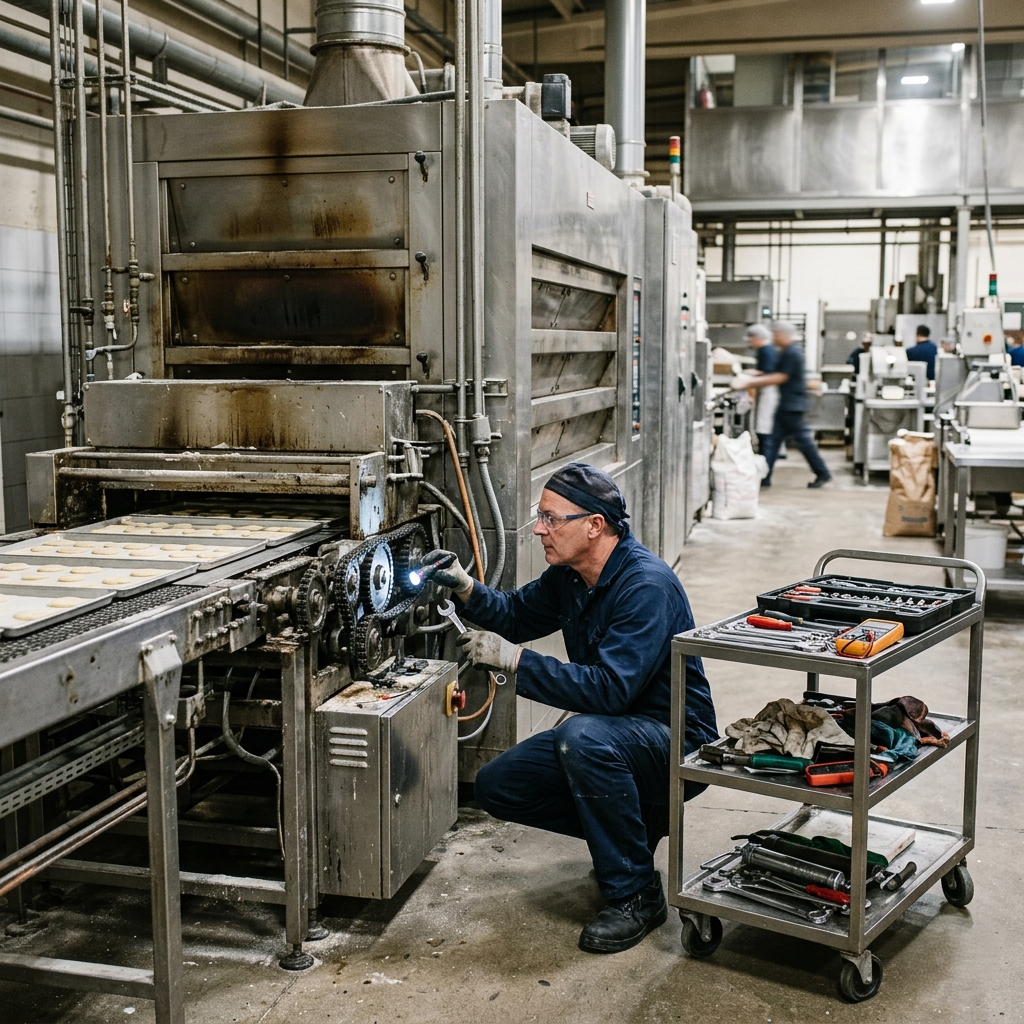
The maintenance schedule exists. The vendor shows up. Parts get replaced. Three weeks later, the same line is down again, or a different component on the same system has failed. This is a pattern that many facilities experience, and a proper bakery equipment maintenance service can help identify what is driving it. Recurring failures are a diagnostic signal, and the equipment is telling you something specific about the structure of your current program.
Gap One: The Interval Is Wrong for Your Production Reality
The most common structural flaw in a commercial bakery maintenance program is a PM interval designed for a production environment that no longer exists. A schedule built when the facility ran one shift is often unchanged after it moves to three. When production volume increases, more shifts, higher line speeds, and seasonal peaks all raise the wear rate on proofers, coolers, and depanners proportionally.
The interval that was correct at one production level becomes too long at a higher one, and failures begin occurring between scheduled visits. Failures tend to cluster in the back half of the interval. Calibrating each system’s interval to its actual wear rate under current production conditions is the structural fix.
A traveling tray proofer running three shifts generates different wear, and the interval should reflect the former. FBS builds tailored maintenance plans around each operator’s specific equipment configuration and production context. A generic, uniform schedule will always leave gaps as production intensity increases.
Gap Two: The Inspection Scope Reaches the Right Failure Points
A maintenance visit that covers the visible and accessible components of a traveling tray proofer or cooler is a strong start, and a thorough inspection goes further. The components that cause the most consequential failures are rarely the easiest to spot. Chain tension at specific load points, drive component wear in legacy systems, and retainer seating across a full depanner platen all require platform-specific knowledge to inspect correctly.
General maintenance visits on complex conveyor systems cover obvious wear points, surface conditions, and visible mechanical issues. A technician with platform-specific knowledge will inspect the exact failure points that a generalist inspection may pass over. The failure signature here is a maintenance visit that finds nothing significant, followed by a failure at a component that was outside the inspection scope.
FBS-certified technicians bring direct expertise in the Latendorf, BEW, and Baker Perkins platforms, where scope gaps most commonly lead to surprise failures. A thorough inspection by a certified technician with platform-specific knowledge identifies failure points that a general inspection may miss. This is what separates a routine visit from one that actually protects uptime.
Gap Three: The Parts Being Installed Perform to Specification
Replacement parts sourced under line-down pressure are often selected by lead time. This creates a failure cycle that resembles equipment deterioration, when it is actually a problem with parts quality. Wrong cup hardness, incorrect retainer inner diameter, or components that wear more quickly will progressively shorten replacement intervals.
The failure signature is the replacement intervals that keep shrinking. Cups replaced six months ago need to be replaced again in three months, and retainers installed just last week are already showing wear. The equipment is performing as expected, given the installed parts; the parts are the variable to address.
A planned parts relationship with a supplier who stocks the full specification range confirms the correct component for each station. FBS maintains an inventory of 8,000 parts across all cup types, retainer variants, and custom components made to specification. This means the right part is available before the line goes down, ensuring the repair is correct the first time.
Gap Four: The Maintenance Program Includes Platform-Specific Expertise
A maintenance program that covers general commercial equipment competency will perform well on standard systems and leave legacy platforms underserved. Traveling-tray proofers, coolers, and legacy Latendorf, BEW, or Baker Perkins systems exhibit platform-specific wear patterns, failure sequences, and early-warning indicators that require direct experience to recognize. These indicators are learned through years of platform work.
The failure signature is major failures on legacy equipment that arrive without apparent warning. The warning signs were present, but unrecognizable to a technician without platform-specific training. A competent general inspection and a platform-aware inspection will produce different outcomes on these systems.
FBS has specialized in traveling tray proofers, coolers, and depanners for over 40 years, with direct lineage to Latendorf’s founding in 1990. That depth of platform knowledge is what makes the difference between an inspection that finds early-warning indicators and one that misses them. Specialist knowledge is the structural foundation that holds the rest of the maintenance program together.
The Structural Diagnosis
Recurring equipment failures are a sign that the current program has a structural gap, whether in interval calibration, inspection scope, parts specification, or platform-specific expertise. Patching the failures will not close the gap. The program structure is the variable that needs to change.
FBS provides certified on-site bakery equipment maintenance services with platform-specific expertise, a full parts inventory, and maintenance plans tailored to your actual production conditions. Whether the gap is an outdated interval or a parts sourcing problem, the diagnosis starts with understanding what your failure pattern is communicating. Call +1 (201) 437-0221 to discuss what your equipment is telling you about your current program.
Frequently Asked Questions
Why does bakery equipment keep failing between maintenance visits?
The most common cause is a PM interval that no longer matches current production intensity. When facilities add shifts or increase line speeds after the maintenance schedule was originally built, wear rates increase while the interval stays the same. Failures then begin occurring in the gap between visits before they happen.
What should a bakery equipment maintenance service include?
A complete bakery equipment maintenance service covers interval-calibrated PM scheduling, thorough inspection of platform-specific failure points, specification-matched parts installation, and technician expertise in the specific equipment platforms being maintained. Programs with gaps in any of these areas will experience recurring failures even with active maintenance. Each element supports the others in keeping the program effective.
Can the wrong replacement parts cause recurring failures in bakery equipment?
Yes, parts sourced under line-down pressure are often selected by availability. Wrong cup hardness, incorrect retainer inner diameter, or components outside the original design spec will wear faster and shorten replacement intervals over time. This failure cycle is often misread as equipment deterioration when the parts are the actual variable.
Why does bakery equipment fail even after a recent maintenance inspection?
A general inspection that does not reach the platform-specific failure points of a traveling tray proofer, cooler, or legacy system will miss the components that cause major failures. Latendorf, BEW, and Baker Perkins systems have early-warning indicators that require direct platform experience to recognize. The inspection was performed competently, and the critical indicators were outside the technician’s frame of reference.
Does bakery equipment need specialist maintenance knowledge to prevent failures?
For complex conveyor systems, platform-specific expertise determines whether an inspection catches early-warning indicators or misses them entirely. Failure patterns on legacy systems are learned through direct platform experience. Specialist knowledge is what closes the gap between a routine visit and one that prevents a major failure.
How often should commercial bakery equipment be serviced?
Service intervals should be calibrated to the actual wear rate, which depends on production intensity, equipment type, and each system’s failure history. A traveling tray proofer running three shifts needs a shorter interval. The correct interval is specific to your equipment and production conditions, and it should be revisited as production changes.
What causes a depanner to keep failing after repairs?
Recurring depanner failures after repairs typically point to one of three issues: the repair addressed the symptom, but did not identify related wear at adjacent components. All three issues are structural, and each one requires a different fix. A thorough post-repair inspection of the entire platen is the starting point for breaking the cycle.
How do we know if our bakery equipment maintenance program has a structural gap?
The clearest signal is a failure pattern that does not respond to increased maintenance activity, repairs that do not hold, or failures on different components shortly after a repair is completed. When failure frequency remains constant despite active maintenance, the program structure is the variable to examine. Interval calibration, inspection scope, parts sourcing, and technician platform expertise are the four areas to evaluate.