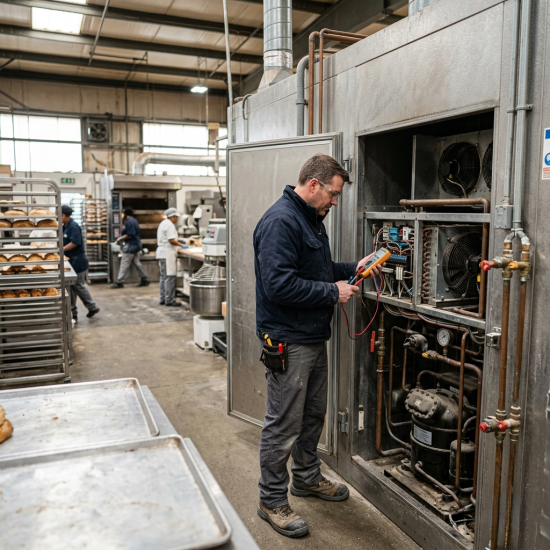
When a traveling tray bread cooler fails or starts to degrade, the vendor a facility calls on matters enormously. Bakery repair services vary widely in their actual capability to handle commercial cooler systems. The four criteria below help plant managers and maintenance directors identify vendors with genuine cooler competency well before a technician sets foot on-site.
Why Platform Knowledge Is the First Thing to Check in Bakery Repair Services
The most important qualification criterion for commercial cooler repair is whether the vendor has specific knowledge of traveling tray cooler systems; general mechanical competency alone is a separate matter entirely. Bakery repair services with genuine platform experience know the failure patterns, wear sequences, and component interactions unique to the traveling tray cooler design.
Legacy Latendorf, BEW, and Baker Perkins cooler systems add a second layer of specificity. These platforms have been out of OEM support for decades, and servicing them requires institutional knowledge that can only come from years of active, hands-on service. A vendor who has worked on Latendorf, BEW, and Baker Perkins coolers carries knowledge that generalist technicians simply cannot replicate.
The qualification question to ask is: “Which traveling tray cooler platforms have your technicians actively serviced?” A vendor with real platform experience will answer with specifics. FBS has provided traveling tray cooler expertise for over 40 years and was founded by former Latendorf Conveying Corporation staff in 1990, making it one of the few providers with direct institutional knowledge of those legacy systems.
Parts Depth: What a Qualified Cooler Repair Vendor Should Carry
A bakery repair services provider with a limited parts inventory will handle routine repairs well, but struggle with repairs that actually stop production. Commercial cooler systems exhibit a broader range of component failures, with distinct wear curves.
A complete cooler parts inventory covers the full range of cooler trays and spare parts, the breadth required to address tray failures across an entire cooler population. For legacy systems, custom fabrication capability also matters. Components that are no longer available through standard sourcing channels can be fabricated to specification, provided the vendor understands the original design and has the machining capability to produce a functional replacement.
The qualification question here is: “What does your cooler-specific parts inventory cover, and how do you handle components that are outside of standard stock?” FBS carries an inventory of over 8,000 replacement parts and fabricates custom components to specification for legacy systems where standard sourcing falls short.
Reconditioned Tray Capability: the Middle Option Many Vendors Miss
Most bakery repair service providers offer two options for cooler tray work: repair a still-serviceable tray or replace it with new stock. Facilities whose tray populations have degraded significantly find that neither option fits their situation well. Reconditioned bread cooler trays provide a cost-effective third path, trays restored to a serviceable condition standard at a cost between new replacement and individual repair.
A vendor that carries reconditioned cooler trays also has the assessment capability to identify when tray population condition warrants such intervention. That determination requires platform knowledge, so it goes well beyond a part number lookup. Tray populations degrade progressively, and a cooler with 30% of its trays in degraded condition affects product handling quality well before a full replacement is justified.
The qualification question is: “Do you offer reconditioned cooler trays as a tray population improvement option?” FBS offers reconditioned bread cooler trays as a confirmed service option for facilities that need tray improvement without a full capital investment.
Repair Scope: the Cooler as a Whole System
A commercial cooler repair that addresses only the presenting mechanical failure, whether it is a drive component, a chain issue, or a mechanical jam, leaves the cooler running below its optimal performance level. Tray population condition affects product handling quality, throughput consistency, and the mechanical load on components throughout the system. Addressing only the symptom leaves the underlying performance gap in place.
A thorough cooler repair scope includes tray population assessment as a standard element, identifying worn or functionally compromised trays, and recommending reconditioned or new tray intervention where warranted. This is the distinction between a vendor who responds to the call and one who resolves the full condition. Whether the repair is scheduled or emergency, a complete scope is the standard to which vendors are held.
The qualification question is: “Does your cooler repair scope include a tray condition assessment, and what happens with those findings?” FBS sends certified technicians on-site and conducts thorough inspections, including tray condition assessment, as part of every commercial cooler repair engagement.
Choosing Bakery Repair Services That Pass All Four Criteria
A bakery repair services provider who meets all four criteria: platform knowledge, parts depth, reconditioned tray availability, and a full repair scope with tray assessment is a vendor who can genuinely service a commercial cooler system. FBS meets all four criteria, with over 40 years of experience with traveling tray coolers, an inventory of 8,000+ parts, custom fabrication capability, availability of reconditioned trays, and certified on-site technicians who conduct thorough inspections.
Whether a facility is managing a current cooler failure or building a preferred vendor list for the future, confirming these four criteria separates capable vendors from confident-sounding ones. The difference is most evident when the line is waiting, and the technician is already on-site.
Call FBS at +1 (201) 437-0221 to discuss your cooler system and confirm the scope of a thorough repair for your specific equipment.
Frequently Asked Questions
What platform experience should a traveling tray bread cooler repair service have?
A qualified vendor should have hands-on service experience with traveling tray cooler systems and, for legacy equipment, active service history with Latendorf, BEW, or Baker Perkins platforms. These systems have been out of OEM support for decades, so institutional knowledge from years of direct service is the only reliable foundation.
What parts inventory should a commercial bread cooler repair service carry?
A complete inventory covers the full range of cooler trays and spare mechanical components, going well past the highest-turnover items. For legacy system repairs, the vendor should also offer custom fabrication services for components no longer available through standard sourcing channels.
Are reconditioned bread-cooler trays available as an alternative to a full replacement?
Yes. Reconditioned bread cooler trays are available from vendors specializing in commercial cooler systems. They serve as a cost-effective option for facilities whose tray populations have degraded but do not require complete replacement. This is a specific capability worth confirming during vendor qualification.
Should a bread cooler repair service inspect the tray condition as part of every repair?
A thorough commercial cooler repair scope should include tray population assessment as a standard element. The presenting mechanical failure is often downstream of tray population issues, and a repair that skips tray assessment resolves the symptom while leaving the underlying performance gap in place.
How do you find a repair vendor with experience on legacy Latendorf, BEW, or Baker Perkins coolers?
Ask directly which traveling tray cooler platforms the vendor’s technicians have actively serviced. Vendors with genuine legacy platform experience will answer with specifics. Those without it give general answers about broad bakery equipment competency.
What is the difference between traveling tray cooler repair and general bakery equipment repair?
Traveling tray coolers are conveyor-driven systems with specific chains, drives, trays, and tension characteristics that differ from other commercial bakery equipment. A technician with general bakery repair experience may recognize the major components but still lack the failure-pattern knowledge required to diagnose and resolve cooler-specific issues efficiently.
What causes traveling tray bread coolers to fail?
Common failure sources include chain wear and tension loss, drive component degradation, and tray population deterioration. These conditions often develop together, since tray condition affects mechanical load and drive stress, which, in turn, accelerate tray wear. A repair scope that addresses the presenting failure and evaluates these interdependencies is the standard that produces lasting results.