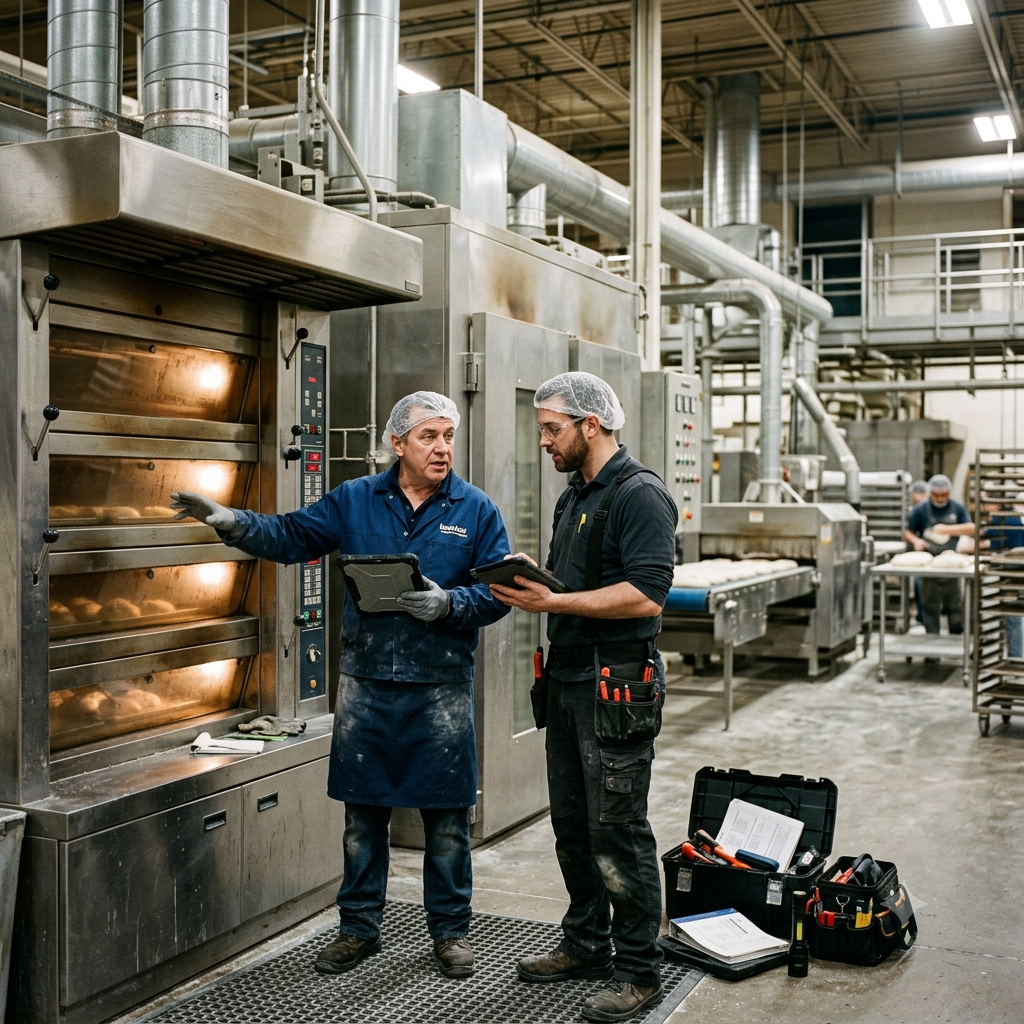
A traveling tray proofer that has run for 25 years just required its third major repair in 18 months. The question on the table is whether fixing it again is the right call, or whether the same capital is better spent on refurbishment or full replacement. Commercial bakery services built around honest, on-site assessments are what make the difference between a sound capital decision and an expensive one. Most operations make this call without that foundation in place.
When Repair Is the Right Call
Repair is the right call when the equipment failure is component-specific, and the underlying platform retains viable service life. Distinguishing between a component failure and the early signs of systemic decline requires a proper assessment from a qualified technician.
A single failed drive component, a worn tray set, a vacuum cup assembly, or a degraded retainer set can be resolved without addressing the broader equipment condition. When the failure is isolated, and the rest of the equipment is in serviceable condition, repair is the appropriate and cost-effective path.
Multiple component failures within a short window, degraded performance across systems, or a pattern of accelerating wear are signs that the platform may need more than a parts fix. Repair in that context extends cost and risk without addressing the underlying condition.
What an Accurate Repair Assessment Requires
An on-site inspection by a certified technician with platform-specific knowledge accurately distinguishes component failure from systemic decline. For facilities running Latendorf, BEW, or Baker Perkins equipment, that distinction also requires institutional knowledge of those specific systems. A phone-based diagnosis or a parts quote alone cannot accurately determine this.
When Refurbishment Makes More Sense
Commercial bakery services, including refurbishment, offer a path many operations overlook entirely. For facilities running legacy Latendorf, BEW, or Baker Perkins systems, refurbishment is often the path that preserves operational continuity without a full capital replacement event.
Refurbishment addresses cumulative wear across multiple systems that have degraded overall performance below an acceptable threshold. The equipment platform is fundamentally sound, including the drive system, the frame, and the core conveyor architecture. Accumulated wear across trays, components, and wear surfaces has compounded to the point where individual repairs no longer restore the performance the operation requires.
This is the middle path: refurbishment restores the equipment to a higher performance baseline, without the capital commitment of full replacement. For a facility running a 30-year-old Latendorf traveling tray proofer with no viable replacement available, refurbishment may be the path to preserving the line’s output capability.
Why Refurbishment Requires Specialist Knowledge
Refurbishment of legacy bakery equipment, particularly Latendorf, BEW, and Baker Perkins systems, requires deep institutional knowledge of those platforms. A refurbishment performed without that expertise produces an uncertain outcome. The scope has to be defined accurately before the work begins, and that accuracy depends on who is doing the assessment.
When Replacement Becomes the Correct Decision
Replacement is the correct decision when the equipment’s failure is systemic, the platform is no longer supportable through repair or refurbishment, or the total cost of continued service has exceeded the cost of a viable alternative. Arriving at that conclusion honestly requires the same quality of assessment as every other option.
Three conditions point toward replacement as the right call:
Systemic Failure: The platform itself has reached the end of viable service life. Multiple systems failing simultaneously, structural degradation that cannot be addressed through refurbishment, or a performance baseline that cannot be restored despite investment, are all signs of systemic failure.
Supportability Limit: Parts are no longer available through any channel, including custom fabrication, and the equipment cannot be maintained at a serviceable level. This is rare for Latendorf, BEW, and Baker Perkins equipment serviced by a specialist, though it applies to certain equipment generations.
Total Cost of Service: The projected cost of continued repair and maintenance over a defined horizon exceeds the cost of replacement. This determination requires an honest projection from a partner with no financial interest in either outcome.
Why the Assessment Determines the Outcome
The repair vs. refurbish vs. replace decision yields a different answer depending entirely on who performs the assessment and what they are capable of doing once it is complete.
A vendor who only repairs equipment has an incentive to recommend repair. A vendor that sells only replacement equipment has an incentive to recommend replacement. A partner capable of executing all three options, including repair, refurbishment, and parts supply, has no structural bias in the assessment. That absence of conflict is what makes the assessment usable.
An on-site appraisal by a certified technician who knows the specific equipment platform produces what a remote diagnosis or a parts quote cannot. It delivers an accurate read of whether the failure is component-specific or systemic, a realistic refurbishment scope if that path is viable, and an honest cost basis for a three-way comparison.
FBS has delivered commercial bakery services of this kind for more than 40 years across traveling tray proofers, cooler systems, and legacy platforms, including Latendorf, BEW, and Baker Perkins. The repair and refurbishment capabilities, along with the parts inventory, are in place to execute whichever path the assessment supports.
Schedule Your On-Site Appraisal With FBS
The most expensive version of the repair vs. replace vs. refurbish decision is the one made without a complete assessment. FBS performs on-site appraisals, executes all three options, and brings 40 years of platform-specific expertise to the assessment with no structural interest in any one outcome.
Before committing to repair, refurbishment, or replacement, schedule an on-site appraisal with FBS. Certified technicians. 40 years of expertise in traveling tray proofer and cooler conflict of interest. Call +1 (201) 437-0221.
Frequently Asked Questions
How do I know if my commercial bakery equipment needs repair or replacement?
The distinction depends on whether the failure is component-specific or systemic. A single failed part, such as a drive component, tray, or wear surface, typically warrants repair when the rest of the equipment is in serviceable condition. When multiple systems fail within a short window, or performance continues to degrade despite repairs, the platform may have reached a point where replacement or refurbishment is the sounder investment.
What is commercial bakery equipment refurbishment, and when is it the right choice?
Refurbishment addresses cumulative wear across multiple equipment systems that have compounded to a point where individual repairs no longer restore acceptable performance. It is the right choice when the core platform is fundamentally sound, including the frame, drive system, and conveyor architecture, and accumulated wear has degraded overall output. For legacy systems like Latendorf, BEW, or Baker Perkins proofers, refurbishment is often the path that preserves operational continuity without a full capital replacement.
When should I replace commercial bakery equipment rather than repair it?
Replacement is the correct decision when the equipment’s failure is systemic, when parts are no longer available to maintain a serviceable condition, or when the projected cost of continued repair over a defined horizon exceeds the cost of a viable replacement. Reaching that conclusion accurately requires an on-site assessment from a partner capable of executing all three options without a financial interest in any one outcome.
Who can provide an honest repair-versus-replace assessment for commercial bakery equipment?
An honest assessment comes from a provider of commercial bakery services who can execute all three options, including repair, refurbishment, and replacement. It therefore has no structural incentive to favor one over the other. The assessment should include an on-site appraisal by a certified technician with platform-specific knowledge of your equipment. Providers with deep expertise in legacy platforms like Latendorf, BEW, and Baker Perkins can make the component vs. systemic distinction accurately.
How long does a traveling tray proofer last before refurbishment or replacement is needed?
Service life varies based on operating conditions, maintenance history, and the degree to which component wear has been proactively addressed. A well-maintained traveling tray proofer can remain in productive service for decades. Many Latendorf and BEW systems installed 30 or more years ago are still operational when properly serviced. The decision to refurbish or replace is better driven by a condition assessment.
What is the difference between repairing and refurbishing bakery equipment?
Repair addresses a specific, isolated failure: a single component that has failed while the rest of the equipment remains serviceable. Refurbishment addresses accumulated wear across multiple systems that have degraded overall performance below an acceptable threshold. Restoring the equipment to a higher performance baseline can be achieved. Refurbishment is a more extensive scope of work and applies when individual repairs have failed to restore the equipment to acceptable performance.
Can Latendorf or BEW traveling tray proofers still be repaired and serviced?
Yes. Latendorf, BEW, and Baker Perkins traveling tray proofers can be repaired, refurbished, and maintained by specialist commercial bakery services providers with platform-specific expertise and parts access. These systems are no longer manufactured, so continued operation depends on a service partner with institutional knowledge of the platform and access to OEM-compatible or custom-fabricated parts. Generalist service providers typically lack the platform knowledge required by these systems.
What should I ask a bakery equipment service provider before scheduling a repair assessment?
Ask whether the provider can perform an on-site appraisal, whether their technicians have direct experience with your specific equipment platform, and whether they are capable of executing repair, refurbishment, and replacement, or only one of those options. A provider limited to a single service type has a structural incentive to recommend it, which undermines the reliability of the assessment.
Is it worth repairing bakery equipment that has already required multiple repairs?
A pattern of repeated repairs within a short timeframe is one of the clearest indicators that the equipment may be in a state of systemic decline. Whether further repair is worth the investment depends on a condition assessment of the full platform, and the assessment should go beyond the most recent failure. An on-site appraisal can determine whether the equipment retains a viable service life or whether refurbishment or replacement would yield a better return on the capital invested.