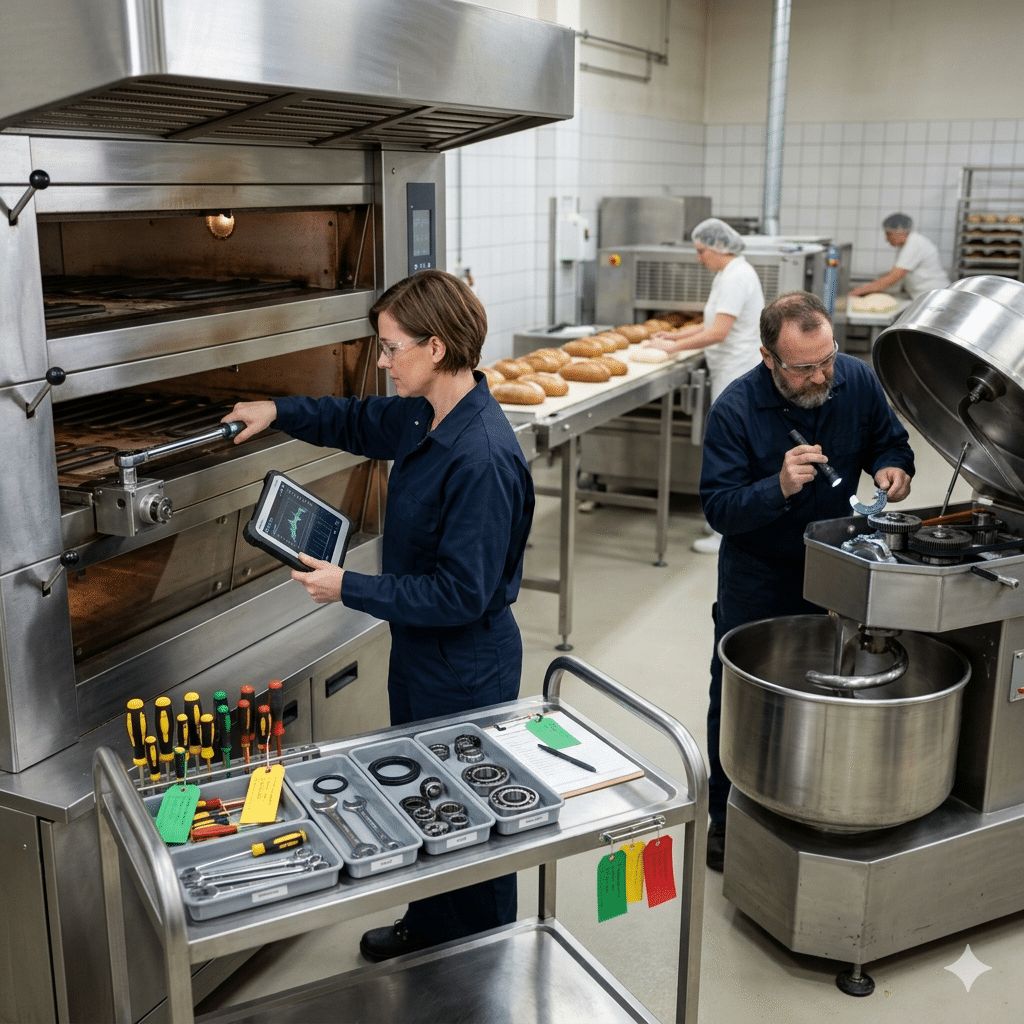
The right bakery equipment maintenance service helps bakery owners feel confident about their budgeting and reduces stress by turning unpredictable repair costs into planned, manageable spending. Emergency labor, panic parts orders, and equipment failures that grow over time are the direct output of a reactive maintenance model. Switching to a structured plan with scheduled visits, stocked parts, certified technicians, and 24/7 availability makes costs predictable and easier to manage.
Two years ago, the maintenance budget made sense. Today it does not. An emergency repair here. A parts order that came in at twice the expected cost because the line was down. A specialist callout for a proofer or cooler that the in-house team could not touch, logged under “outside services” with no plan to prevent the next one.
The problem is the model. A reactive maintenance approach defers cost and then multiplies it. Every dollar withheld from a planned inspection returns as emergency labor, premium parts pricing, and production losses that never appear on the original invoice. This article breaks down how that cost multiplication happens, what a structured plan changes on the budget line, and what to look for in a service provider that can replace cost variability with cost stability.
Why Reactive Maintenance Always Costs More
Reactive maintenance feels like cost avoidance. No scheduled visit means no service invoice. The actual cost of reactive maintenance, however, runs through three specific budget mechanisms that are structurally more expensive.
Emergency Labor Runs at Unplanned Rates
When equipment fails without warning, repair labor is mobilized. That means overtime rates for in-house staff pulled off other work, outside contractor callouts at premium hourly rates, or specialist fees for equipment that the internal team lacks the training to handle. The labor cost of a reactive repair is higher than that of a scheduled one. The work may be identical. The rate structure is different.
A certified technician who visits on a planned schedule performs the same inspection and repair work at a fraction of the cost of an emergency dispatch. The difference is entirely in how the visit was arranged.
Panic Parts Pricing Adds Cost Without Adding Value
A parts order placed with the line down carries two compounding cost penalties. Suppliers who know the buyer have no time to compare price quotes. Expedited shipping adds a high cost to get parts moving faster, a premium paid for urgency.
A facility with no pre-established parts relationship and no standing inventory absorbs both penalties on every unplanned repair. A service provider like FBS, with a deep inventory of 8,000+ parts, can fulfill planned replenishment orders at standard pricing, reducing downtime and operational disruptions. The parts cost stays the same, and the urgency markup disappears, ensuring reliable service and cost predictability.
Deferred Inspection Creates Compounding Failures
Skipping a scheduled inspection allows wear to progress undetected. A worn retainer that a planned visit would have flagged and replaced at parts cost becomes a vacuum failure that requires a technician dispatch, a line stop, and likely additional damage to adjacent components. Each stage of deferral multiplies the eventual repair cost.
This is the mechanism behind the most expensive items in most reactive maintenance budgets: failures that were allowed to grow due to missed inspection intervals.
What a Structured Maintenance Plan Actually Changes
A structured bakery equipment maintenance plan restructures where costs land, moving them from the emergency column to the planned column, where they can be budgeted, managed, and controlled.
Scheduled Labor Replaces Emergency Labor
FBS provides on-site maintenance visits performed by certified technicians on the operator’s schedule. Planned visits carry standard labor rates. They also create the inspection record that makes the next visit more efficient, identifying wear patterns, flagging at-risk components, and building the equipment history that reactive maintenance never generates.
Inventory Depth Eliminates Panic Pricing
With 8,000+ parts in stock and the capability to manufacture custom components to specification, FBS eliminates the sourcing gap that drives panic pricing. Parts needed for a planned repair are ordered at standard cost on a standard timeline. Parts needed for non-standard or legacy equipment from Baker Perkins, BEW, and Latendorf are available without an open-market search under line-down pressure.
Scheduled Inspection Stops Compounding Before It Starts
FBS’s certified technicians perform thorough on-site inspections during every maintenance visit. Worn components are identified and replaced during planned visits at parts cost, on a scheduled labor rate, without a line stop. The inspection pays for itself in repairs that are prevented.
Why 24/7 Availability Belongs in the Budget Conversation
Most operators think of 24/7 service availability as a safety net. The more accurate framing is that it is a budget line item expressed in downtime prevented.
A bakery equipment maintenance service without after-hours availability creates a specific cost exposure. When equipment fails outside business hours, the operator’s options are to stop production or to improvise. Both carry costs. A night-shift line stop that runs until morning represents lost production volume, labor costs for idle staff, and potential downstream delays, all of which exceed the cost of having a service provider available to respond at 2 AM.
FBS maintains 24/7 on-call availability to close this exposure. In a 24-hour production facility, after-hours availability is the financial backstop that prevents low-probability events from becoming high-cost ones.
Tailored Plans vs. Standard Contracts
A standardized maintenance contract charges for visits and labor regardless of what a specific facility actually needs. That means over-servicing low-risk equipment while under-servicing high-wear systems that drive the most failure risk.
A tailored bakery equipment maintenance plan is built around the operator’s specific equipment profile, which systems accumulate wear fastest, which require specialized knowledge, and what service frequency aligns with the production schedule without generating unnecessary visit costs.
A tailored bakery equipment maintenance plan, built around the operator’s specific equipment profile, makes bakery operators feel understood and prioritized. FBS’s on-site appraisal assesses equipment, usage patterns, and maintenance gaps, producing a precise plan that aligns with their needs and budget, unlike standard contracts that may over- or under-service.
A Better Way to Spend on Maintenance
An unpredictable maintenance budget is a symptom of a reactive maintenance model. The fix is to spend differently planned visits in place of emergency callouts, stock parts in place of panic orders, and schedule inspections in place of compounding failure.
FBS provides bakery equipment maintenance services on your schedule, with certified technicians, 8,000+ parts on hand, and maintenance plans tailored to your operation and budget. Call (201) 437-0221 to discuss what a structured, cost-stable plan looks like for your facility.
Frequently Asked Questions
Why does reactive bakery equipment maintenance cost more than scheduled maintenance?
Reactive maintenance triggers three compounding cost mechanisms: emergency labor at overtime or specialist rates, parts orders placed under line-down pressure at premium pricing, and deferred inspection that allows minor wear to escalate into major repair events. Each of these costs exceeds its planned equivalent because the timing and circumstances are beyond control. A structured bakery equipment maintenance plan addresses all three by replacing urgent, unplanned costs with scheduled, predictable costs.
What does a commercial bakery equipment maintenance plan include?
A commercial bakery equipment maintenance plan typically includes scheduled on-site technician visits, thorough equipment inspections, preventive parts replacement, and documented service records. Plans should be tailored to the facility’s specific equipment profile and production schedule. A provider with deep parts inventory and the ability to service specialized equipment proofers, coolers, and legacy lines delivers more complete coverage.
How should a bakery equipment maintenance plan be structured?
A bakery equipment maintenance plan should be structured around three variables: the specific equipment in the facility, the production schedule that determines service windows, and the failure-risk profile of each system. High-wear equipment warrants higher inspection frequency. Low-risk equipment may require only periodic visits. An on-site appraisal that identifies current wear levels, deferred maintenance, and any specialized service requirements makes the plan financially accurate.
Does the 24/7 availability of bakery equipment service affect maintenance costs?
Yes, 24/7 availability affects the cost exposure from after-hours equipment failures. A facility without access to a qualified technician outside business hours faces a binary choice when equipment fails on a night shift: stop production or improvise. Both options carry costs that exceed the value of having a service provider on call. In continuous-production environments, after-hours availability functions as a cost-containment tool.
What is the most expensive line item in a bakery maintenance budget?
For most commercial bakeries operating on a reactive maintenance model, emergency labor is the largest and least controllable line item. Emergency callouts draw on overtime rates, outside contractor fees, or specialist billing that was never planned for. The second-largest cost driver is typically unplanned parts orders placed under line-down pressure, where expedited shipping and supplier pricing premiums compound the base parts cost.
How can a bakery reduce equipment downtime costs?
The most effective way to reduce equipment downtime costs is to shift from reactive to preventive maintenance, catching wear before it causes failure. This requires scheduled on-site inspections by certified technicians, access to deep parts inventory for rapid planned replenishment, and a service provider with after-hours availability for situations that arise outside standard hours.
Which equipment in a commercial bakery requires specialized maintenance knowledge?
Proofers, coolers, and legacy production equipment from manufacturers such as Latendorf, BEW, and Baker Perkins typically require technician expertise that in-house maintenance teams do not carry. When these systems fail, the repair escalates to an outside specialist, almost always at unbudgeted rates. A bakery equipment maintenance service with certified technicians trained across these equipment categories eliminates the escalation step and the associated cost premium.
What is the difference between a bakery equipment maintenance contract and a maintenance plan?
A maintenance contract is standardized, and it defines a service frequency and scope applied uniformly across customers. A maintenance plan is built for a specific facility, based on its equipment profile, production schedule, and identified failure risks. A tailored plan allocates service visits where they have the highest cost-prevention value, making the budget more accurate and controlled.
How do parts inventory levels affect bakery maintenance costs?
Parts inventory depth determines whether a maintenance provider can fulfill repairs at standard cost or must source components under pressure. When a service provider carries deep stock, thousands of replacement parts are readily available, and planned repairs are filled at standard pricing on standard timelines. For facilities maintaining legacy or specialized equipment, access to custom-manufactured components eliminates the sourcing gap.
When should a commercial bakery consider switching maintenance models?
The clearest signal is budget unpredictability. If maintenance spend varies significantly quarter to quarter, driven by events that were never planned for, the underlying model is reactive. Secondary signals include recurring specialist callouts for equipment that the in-house team cannot service, parts orders consistently placed under line-down pressure, and an absence of documented inspection history. These patterns are resolved through a deliberate shift to a structured model for bakery equipment maintenance with a qualified service provider.