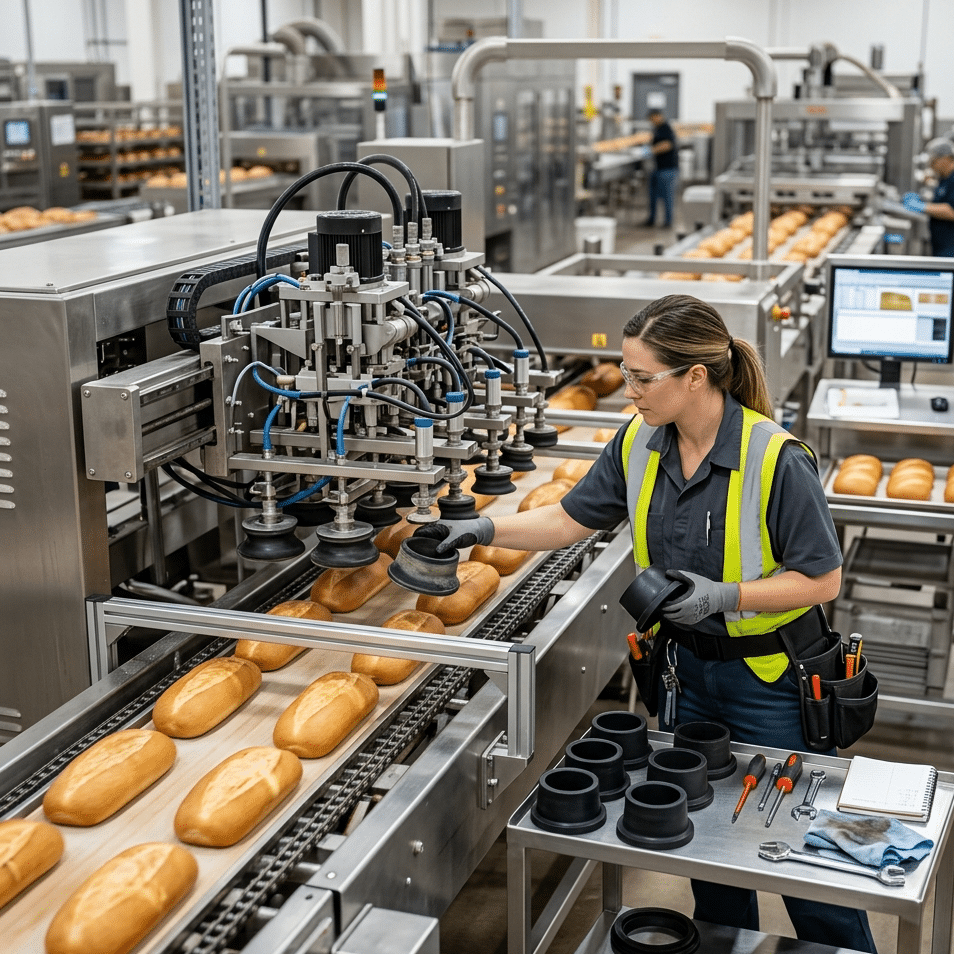
Commercial baking systems rely on consistent depanner performance. Regular inspections based on visible wear and performance signals help maintenance staff feel confident in their proactive role to prevent issues.
Observation practices focus on suction stability, feed consistency, and product alignment during standard production runs. Maintenance planning is built through recorded performance trends gathered from routine equipment inspections. Production continuity is supported through structured care that maintains steady equipment function and consistent output across baking lines.
What Wear Actually Looks Like Before the Cup Fails
The goal of a pre-failure inspection is to identify cups entering the wear window early. Recognizing these signs helps operators feel capable of preventing line disruptions before they happen.
Surface Deformation On The Contact Face
Cups that have flattened on the contact face, developed edge curl, or show visible cracking in the cup body are the easiest to catch visually. This indicator is often the last one to appear. By the time the cup looks worn, it has already affected product placement.
Inconsistent Vacuum Hold
A product that releases early, requires higher vacuum pressure to hold, or lands inconsistently across the platen often indicates cup wear before mechanical issues arise. Understanding these vacuum signals helps operators troubleshoot effectively and prevent line disruptions.
Hardening Or Loss Of Compliance
This matters most on soft cup variants, including Soft Metal Detectable, Soft Translucent, and Blue Soft Metal. Use tactile checks by pressing the cup face against a new cup of the same type to detect hardening or loss of compliance, providing a reliable method for identifying wear beyond visual cues.
Retainer Condition
A cup in good condition paired with a worn retainer will still underperform. Check retainers for lost holding tension, visible deformation, or any movement of the cup on the post. Retainer wear tends to run parallel to cup wear and is missed when inspections focus only on the cup itself.
These are observation-based indicators. To optimize maintenance, establish a recommended replacement interval based on line speed, product type, and volume, ensuring proactive planning and reducing unexpected line stops.
Why Soft Cups and Metal Detectable Cups Wear Differently
The type of cup running on your line affects how you should approach condition checks. Different formulations wear in different ways.
Standard Profile Cups
Metal Detectable, Translucent, Red Cup, and flat profiles, wear through surface deformation and edge fatigue. The wear is progressive and visible. Regular visual inspection during line checks is usually enough to catch them in the wear window before failure.
Soft Cups
Soft Metal Detectable, Soft Translucent, and Blue Soft Metal wear through gradual hardening and loss of flexibility. That wear is functionally significant but visually subtle. A soft cup can look completely intact while no longer providing the compliance the product requires. For soft cup lines, a compliance check should be included in the inspection routine alongside the visual pass. Press the cup face against a new cup. That tactile check is faster and more reliable than a visual assessment alone.
Metal Detectable Cups
It carries one additional consideration. The detectability additive does not degrade separately from the cup body. A cracked or fragmented detectable cup of any type should be treated as a contamination risk and replaced right away. A compliance program tracking detectable cup condition should treat physical damage as a zero-tolerance indicator, regardless of the cup’s position in the replacement cycle.
Building a Replacement Event, Not Just a Replacement
When inspecting cups in the wear window, view replacement as an opportunity to ensure everything is optimized. A complete depanner cup replacement covers more than just the cups, reinforcing a sense of thoroughness and quality in maintenance.
Replace the full platen run. Partial replacement creates inconsistent vacuum performance across the platen. If some cups are in the wear window, the rest are closed. Replacing the full run gives you a consistent baseline and a clean starting point for the next observation cycle.
Replace retainers at the same time. Retainer wear is frequently concurrent with cup wear and is frequently missed when only cups are ordered. If the platen is already being pulled, inspect each retainer and replace any that show deformation, lost tension, or cup movement. FBS stocks both retainer sizes, 5/16″ and 3/8″, alongside the full cup range, so a single order covers both.
Confirm and correct your cup spec. The replacement event is the right time to verify that the cup type, hardness, and detectability status running on your line match the correct spec for your application. If the line has been running the wrong cup type, the replacement event is the right time to correct it.
Check the platen posts. Worn or damaged posts will accelerate cup and retainer wear in the next cycle. A few minutes on post-conditioning during the replacement event can extend the life of the next cup set.
FBS carries the full range, including Metal Detectable, Soft Metal Detectable, Translucent, Soft Translucent, Clear Flat, Red Flat, Red Flat Metal, Red Cup, Blue variants, and custom parts made to specification for non-standard applications.
Stocking Spares: What to Keep on the Shelf
The difference between a planned depanner cup replacement and an unplanned line stop often comes down to whether the right cups are already on site. Stocking spares is straightforward, but it has to be specific.
The right spare is the correct cup type for your application and the correct retainer size for your specific depanner. A facility that stocks the wrong cup type or the wrong retainer size has inventory that cannot be used when a planned replacement comes up.
For facilities running a metal-detection compliance program, stock only detectable cups and detectable retainers. Mixing detectable and non-detectable spare stock creates the risk of installing the wrong part during a replacement. That is a compliance issue.
A supplier that carries the full range means replenishment orders carry no lead-time uncertainty. FBS maintains an inventory of over 8,000 parts, covering every cup variant and retainer size in the depanner cup range. When your replacement cycle runs on a schedule, that inventory depth means availability is never the limiting factor.
FAQs
What are the signs that depanner cups need to be replaced?
The main pre-failure indicators are surface deformation on the contact face, inconsistent vacuum hold or early product release, hardening in soft cup variants, and retainer wear that allows cup movement on the post. These signs typically appear before a full vacuum failure. Routine visual and tactile inspection catches them earlier than waiting for a line stop.
Do soft depanner cups wear out faster than standard cups?
Soft depanner cups wear differently, though the rate varies by line and application. Standard cups wear through surface deformation that is visible on inspection. Soft cups wear through gradual hardening and loss of compliance, which can appear intact while no longer performing as designed. Maintenance managers running soft cup lines should add a tactile compliance check to their inspection routine.
Should all depanner cups be replaced at once or just the worn ones?
The full platen run should be replaced, which visually failed. Partial replacement results in inconsistent vacuum performance across the platen because cups installed at different times are at different points in their wear cycle. Replacing the full run gives a consistent performance baseline and makes the next inspection cycle more reliable.
Should spare depanner cups be kept in stock?
Yes, and the spare needs to be the correct cup type and correct retainer size for the specific depanner. Having the wrong spare on the shelf is functionally the same as having no spare when a planned replacement comes up. Facilities running metal detection compliance programs should stock only detectable cups and retainers, with no mixing of detectable and non-detectable spare inventory.
How often should depanner cups be replaced?
There is no universal depanner cup replacement interval because wear rate depends on line speed, product type, production volume, and cup material. Working from observable wear indicators, including surface condition, vacuum performance, cup compliance, and retainer integrity, is more reliable.
Can depanner cups be replaced without a technician?
Depanner cup replacement is a standard PM task that maintenance staff and senior production operators handle routinely. The critical steps are confirming the replacement cup matches the current spec for type, hardness, and detectability, replacing retainers at the same time as cups, and inspecting platen posts for wear that could accelerate the next replacement cycle.
What is the difference between metal detectable and standard depanner cups?
Metal detectable depanner cups contain an additive that makes them identifiable by metal detection equipment, which is a requirement for facilities running foreign object contamination compliance programs. Standard cups perform the same vacuum and release function, though they would not be detected if a cup fragment entered the product stream. Facilities with active metal-detection programs should run detectable cups exclusively and keep detectable and non-detectable cups separate in the spare parts inventory.
What retainer size is needed for depanner cups?
Depanner cup retainers are available in two standard sizes: 5/16″ and 3/8″. The correct size depends on the specific depanner model and platen post diameter. When ordering replacement cups, confirm the retainer size at the same time and replace retainers alongside the cups to keep the full replacement event consistent.
What happens when the wrong type of depanner cup is running on a line?
Running the wrong cup type, whether incorrect hardness, wrong profile, or a standard cup where a soft cup is required, will result in inconsistent vacuum hold, product damage, or placement errors that can resemble mechanical problems. A depanner cup replacement event is the right time to confirm the current spec is correct. A parts supplier carrying the full range can help confirm the spec before the next replacement order is placed.
Are custom depanner cups available for non-standard depanner configurations?
Yes. FBS offers custom parts made to specification for lines that do not run a standard cup profile. A planned replacement event on a non-standard line should correct the spec. Custom cup dimensions can be matched to specific depanner configurations, so the replacement event sets the line up with the right part going forward.