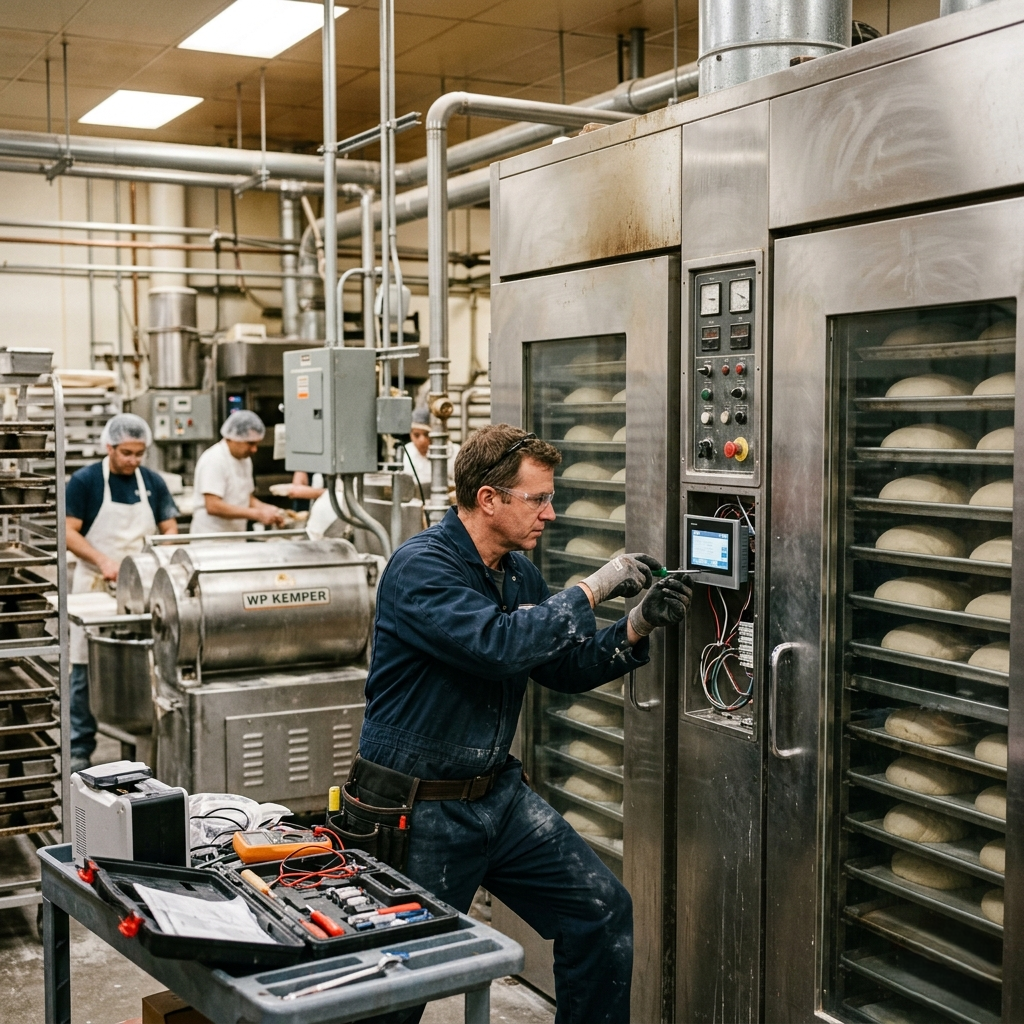
Bakery proofer replacement is a decision that has already been made by the time a plant manager picks up this article. The decision to keep a legacy Latendorf, BEW, or Baker Perkins traveling tray proofer running has been weighed and finalized. What follows is the work of executing that decision well over a multi-year horizon.
A legacy proofer stays profitable through consistent, category-level component planning. The three wear categories that define long-term throughput are trays, motion components, and platform-specific parts.
Component Category One: Tray Population and Long-Term Throughput
Tray population is the wear category with the longest horizon and the most gradual performance impact in a legacy traveling tray proofer. It is the easiest to defer and the most consequential to mismanage across a multi-year asset strategy.
Trays degrade progressively across the population, and the performance impact accumulates quietly over time. Inconsistent product handling, reduced throughput consistency, and mechanical interference from trays beyond the conveyor path’s tolerance range are all signs that population degradation has been underway for some time.
A tray population strategy replaces cohorts of trays at similar wear stages on a planned cycle. This maintains the overall population above a minimum performance threshold without triggering a full-population capital event. FBS maintains a large selection of proofer trays, parts, and accessories for legacy traveling tray platforms, which is the supply infrastructure a cohort strategy requires.
Component Category Two: Motion Components in a Planned Replacement Program
Motion components are the mechanical drive infrastructure of a traveling tray proofer. Rollers, axle pins, and fingers follow a more abrupt wear pattern.
A worn roller that reaches its failure point can cause a chain jam or a tray derailment, with a short warning window. The asset strategy for motion components is therefore interval-based. Platform specificity matters here as well. A BEW system requires BEW-specification components, and FBS stocks confirmed platform-specific roller SKUs for BEW systems, including the BEW Nylatron Roller (2″ Dia.) and the Type F Roller (1 13/16″ Dia.).
Axle pins and fingers are the mechanical connection points where wear produces chain skip, tray misalignment, and drive irregularity. These are the precursor conditions that precede larger failures when left unaddressed at planned intervals. Including them in the motion component replacement program is what separates interval-based management from reactive maintenance.
Component Category Three: Platform-Specific Parts and the Bakery Proofer Replacement Strategy
The long-term profitability of a legacy Latendorf, BEW, or Baker Perkins proofer depends on whether components unique to that platform can be sourced. For components outside standard commercial inventory, custom fabrication capability is the variable that determines whether the asset strategy is viable.
Latendorf, BEW, and Baker Perkins traveling tray proofers contain components designed for those specific platform generations with no direct commercial equivalent. A supplier who can fabricate replacement parts to specification fills the sourcing gap that generic parts suppliers cannot address. FBS’s 40 years of specialization in these platforms, combined with an inventory of over 8,000 parts, makes platform-specific component sourcing a strategic asset for any long-horizon bakery proofer replacement plan.
Fabricating to specification for a legacy platform component requires knowing the original specification. That institutional knowledge comes from decades of hands-on platform work and is what distinguishes a true specialist from a general industrial parts distributor.
Recognizing When Component Replacement Becomes Refurbishment Scope
A legacy proofer asset strategy that executes simultaneous individual component replacements across all three categories has been added to the refurbishment scope. Managing that accumulated work as individual transactions creates coordination complexity without the performance baseline reset that a structured refurbishment provides.
Individual component replacements are the right intervention for isolated wear within a single category. When wear has accumulated across trays, motion components, and platform-specific parts simultaneously, a scoped refurbishment event is the more efficient path forward. FBS offers both refurbishment capability and on-site appraisal to determine whether a legacy proofer’s current state has reached this threshold.
A scoped refurbishment, planned and executed with a specialist who covers all three component categories in a coordinated sequence, produces a higher performance baseline. It also resets the replacement cycle across the full system.
The Foundation of a Profitable Legacy Proofer Strategy
A legacy traveling tray proofer stays profitable for the long haul when its three component categories are managed through planned replacement programs. The variable that determines whether that strategy is executable is parts availability, which is the core strength of a reliable bakery proofer replacement partner.
FBS stocks a large selection of proofer trays, parts, and accessories for Latendorf, BEW, and Baker Perkins systems, with custom fabrication capability for non-standard and platform-specific components. Whether the need is tray cohort replacement, sourcing motion components, or platform-specific fabrication, FBS has the inventory and institutional knowledge to support a long-term strategy.
Call +1 (201) 437-0221 to discuss your legacy proofer’s component replacement strategy with the FBS team.
Frequently Asked Questions
What is a bakery proofer replacement strategy, and how is it different from reactive maintenance?
A bakery proofer replacement strategy manages component wear across defined categories on a planned basis before failures occur. Reactive maintenance replaces parts after they fail, while a strategic approach replaces components at wear thresholds that prevent production disruptions and control capital deployment over a multi-year horizon.
How is tray replacement managed in a legacy traveling tray proofer?
Legacy proofer tray replacement is most effectively managed through a cohort approach, replacing groups of trays at similar wear stages on a planned cycle. This approach requires a supplier who stocks platform-specific trays in sufficient quantity to fulfill cohort orders reliably.
What motion components need planned replacement in a Latendorf or BEW traveling tray proofer?
The primary motion components requiring planned replacement are rollers, axle pins, and fingers. In BEW systems, this includes the BEW Nylatron Roller (2″ Dia.) and the Type F Roller (1 13/16″ Dia.), among other platform-specific SKUs.
Where can replacement parts be sourced for a legacy Latendorf traveling tray proofer?
Legacy Latendorf proofer parts require a specialist supplier with platform-specific inventory depth and, for non-standard components, custom fabrication capability. FBS maintains inventory and fabrication capability for Latendorf, BEW, and Baker Perkins systems.
When should the replacement of a legacy proofer component be considered a full refurbishment?
When wear has accumulated across all three component categories simultaneously, the scope has crossed from individual replacement into refurbishment territory. An on-site appraisal can help determine whether the current system state has reached this threshold.
Can legacy BEW or Baker Perkins proofer components be fabricated if they are no longer in standard inventory?
A supplier with institutional knowledge and fabrication capability, working to original platform specifications, can produce replacement parts for legacy components. This custom fabrication capability is a critical part of a long-horizon asset strategy for Latendorf, BEW, and Baker Perkins proofers.
How does tray population degradation affect production before a visible failure occurs?
Tray population degradation affects production gradually through inconsistent product handling and reduced throughput consistency. These performance impacts accumulate well before any individual tray produces a visible mechanical failure.
What is the difference between proofer maintenance and a proofer asset strategy?
Maintenance addresses individual failures and scheduled service intervals. An asset strategy manages wear across component categories that determine long-term throughput, with a supplier relationship capable of supporting planned cohort replacement, platform-specific parts sourcing, and scope for refurbishment when individual replacement work has accumulated beyond a viable threshold.