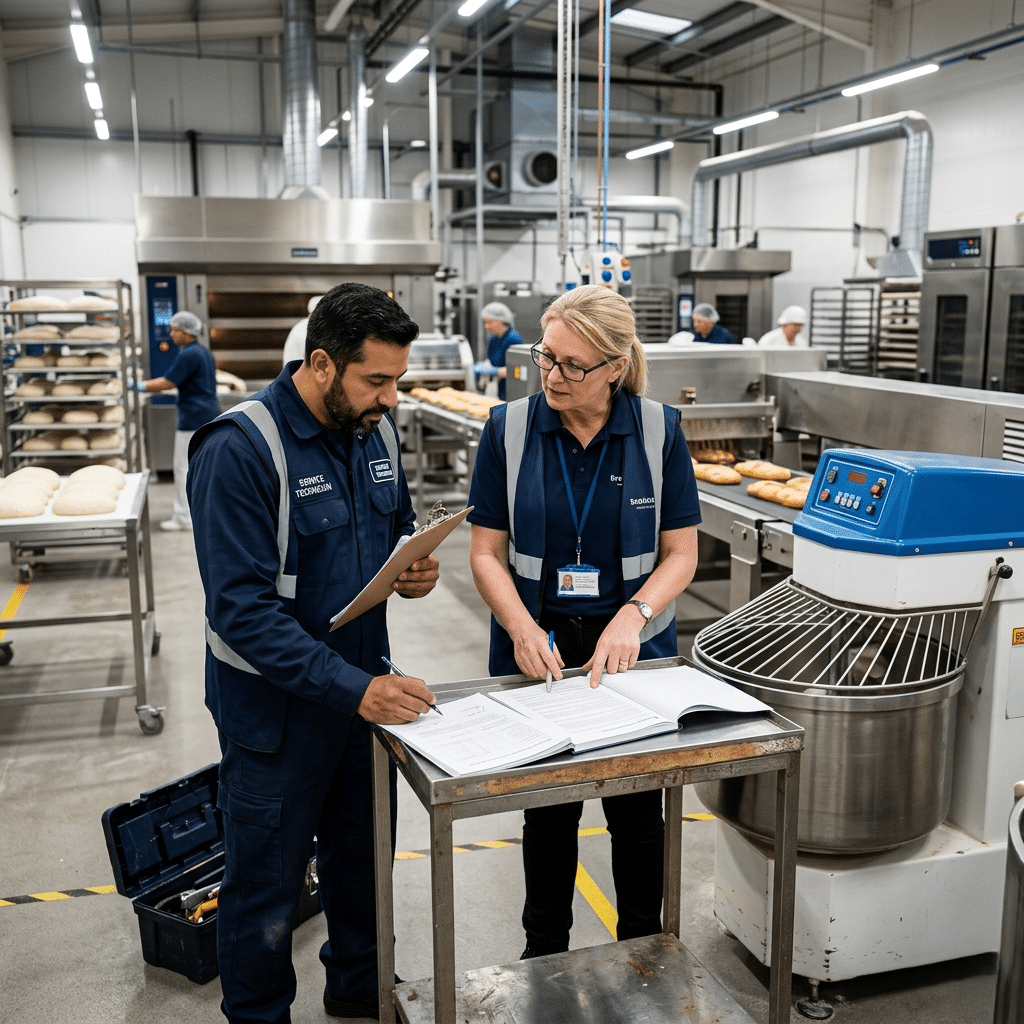
The commercial bakery repair service agreement on your desk looks solid. It covers maintenance visits, repair response, and parts support. The vendor walked through every section, and it all sounded thorough.
Then the proofer goes down at 11 PM on a Friday. The agreement’s “availability” clause turns out to mean a callback window the next business morning. That is the moment the gap becomes visible.
Coverage gaps in service agreements are almost always due to language issues. This guide helps you find them before you need the coverage.
Coverage Gap One: Availability Language That Leaves You Exposed
The most consequential coverage gap in a commercial bakery repair service agreement is availability language that says “emergency response available” without specifying that a certified technician can be dispatched at any hour, including nights, weekends, and holidays.
“Available” does no work in a contract without a definition attached to it. In practice, “after-hours support provided” can mean anything from a live 24/7 dispatch line to a monitored voicemail with a next-morning callback. The agreement language rarely makes this distinction.
What to look for in the agreement: Explicit language confirming 24/7 on-call availability and a defined response modality that specifies live contact and technician dispatch capability. A callback window is a separate thing from dispatch capability.
What to ask for in writing: Confirmation that certified technician dispatch is available at 2 AM on a Saturday and that this availability is covered within the standard agreement terms. FBS provides 24/7 on-call availability as standard with every commercial bakery repair service plan.
Coverage Gap Two: Equipment Scope That Excludes Your Most Critical Systems
Standard service agreements frequently include exclusion language buried in the covered equipment schedule that removes legacy Latendorf, BEW, or Baker Perkins systems from coverage because they are “out of OEM support” or “non-standard equipment.”
This exclusion is written into the agreement because the vendor lacks the platform-specific knowledge to service those systems. Legacy traveling tray proofers and coolers are among the highest-consequence equipment in most commercial bakery operations and among the most likely to be excluded from standard agreements.
The exclusion language is written to appear as a reasonable carve-out. “Equipment no longer supported by the original manufacturer” can quietly remove the most operationally critical system in your facility from the coverage you are paying for.
What to look for in the agreement: A covered equipment schedule that explicitly names the equipment platforms and system generations in the facility, including specific Latendorf, BEW, or Baker Perkins models where applicable. Any exclusion language for legacy or discontinued equipment should be identified and negotiated out.
What complete scope looks like: Coverage that explicitly extends to legacy systems, with no platform carve-outs, and confirmed service capability for the specific equipment generations in your facility. FBS has 40+ years of platform-specific expertise with Latendorf, BEW, and Baker Perkins systems.
Coverage Gap Three: Parts Language That Leaves Sourcing Risk With You
A commercial bakery repair service agreement that covers labor but does not address parts sourcing, inventory depth, or custom fabrication transfers the cost and delay risks of parts availability directly to the operator. That risk lands at the worst possible moment.
Labor-only agreements are the most common form of undisclosed parts gap. The technician’s time is covered. Parts procurement falls to the operator. In a line-down event, this means sourcing components under pressure while a technician waits on-site.
Agreements that include parts coverage often fail to specify inventory depth or the availability of non-standard components. An agreement that covers “standard bakery replacement parts” for a facility running legacy equipment or non-standard cup specifications may fall short of what the facility actually needs.
What to look for in the agreement: Explicit parts coverage language that addresses inventory depth, custom fabrication capability for non-standard components, and clarity on who bears cost and lead time risk.
What to ask for in writing: Confirmation that the provider carries inventory for the specific platforms in the facility and has custom fabrication capability for legacy and non-standard components. FBS maintains an inventory of 8,000 or more parts and fabricates custom components to specification.
Coverage Gap Four: Service Scope That Leaves Visit Standards Undefined
A maintenance visit defined only as “scheduled maintenance inspection” in a service agreement can mean anything from a certified technician’s thorough multi-system inspection to a brief walkthrough by a generalist. The agreement language alone will not tell you which one to expect.
Visit frequency commitments carry no value without visit scope definitions. An agreement that specifies quarterly maintenance visits without defining inspection depth, covered systems, or technician certification requirements creates no enforceable service standard.
What to look for in the agreement: Explicit scope language for each visit type, including which systems are inspected, what the inspection covers at the component level, and what certification or platform expertise the attending technician is required to hold.
What a complete visit scope includes: A certified technician, documented multi-system inspection, written findings, and a defined escalation path when the inspection identifies components requiring repair. Certified technicians with platform-specific expertise conduct FBS maintenance visits and include thorough on-site inspections with documented findings.
Coverage Gap Five: A Standard Plan Applied to a Non-Standard Operation
A service agreement built from a standard template and applied without modification to a specific facility’s equipment mix, production schedule, and legacy platform profile is an unrealistic maintenance program. Unrealistic maintenance programs are one of the problems a qualified commercial bakery repair service exists to solve.
Standard agreements are designed for an average facility. A commercial bakery running three-shift production, legacy Latendorf proofers, and multiple depanner lines with different cup specification requirements is a template-driven agreement, and it will have gaps across nearly every section.
What to look for in the agreement: Evidence that coverage terms were built around the specific equipment in the facility, visit cadence calibrated to actual production intensity, parts coverage that reflects specific cup types and legacy components, and availability commitments that match actual operating hours.
What a tailored agreement looks like: Every section reflects the facility’s real equipment, schedule, and operational requirements. FBS builds maintenance plans to suit the business.
What a Gap-Free Agreement Actually Covers
A commercial bakery repair service agreement that closes all five gaps protects production continuity. It specifies 24/7 certified technician dispatch, names legacy platforms explicitly in the covered equipment schedule, addresses parts depth and custom fabrication, defines visit scope and technician certification, and reflects the actual facility.
A standard agreement that leaves any one of these gaps open is a liability dressed as coverage. The gap will surface eventually, whether during contract review or during a line-down event at 11 PM.
FBS provides commercial bakery repair service on tailored plans built around your equipment, schedule, and production requirements. Call +1 (201) 437-0221 to discuss what a complete, gap-free service agreement looks like for your operation.
Frequently Asked Questions
What should a commercial bakery repair service agreement include?
A complete agreement should address five areas: 24/7 certified technician availability; an equipment scope that explicitly names all platforms in the facility; parts coverage with inventory depth and custom fabrication capability; a defined visit scope with technician certification requirements; and tailored terms built around the specific facility. Agreements that leave any of these undefined create coverage gaps that become visible only during a failure event.
What does “24/7 availability” mean in a bakery service agreement?
In a well-written service agreement, 24/7 availability means a certified technician can be dispatched at any hour, including nights, weekends, and holidays, without a surcharge or delayed response window. It is distinct from “after-hours support provided,” which often means a callback the next business morning. The agreement should specify live dispatch capability, confirmed in writing.
Should a bakery service agreement cover legacy Latendorf and Baker Perkins equipment?
Yes, and any exclusion of legacy equipment should be identified and negotiated before signing. Legacy traveling tray proofers and coolers from platforms like Latendorf, BEW, and Baker Perkins are frequently removed from standard service agreements because generalist vendors lack the platform expertise to service them. A complete agreement explicitly names legacy platforms in the covered equipment schedule with no carve-outs.
Should a bakery equipment service agreement include parts coverage?
A complete agreement should address parts sourcing, inventory depth, and custom fabrication capability, going well past labor coverage alone. Labor-only agreements leave the operator responsible for sourcing components during a line-down event, which adds lead time and cost pressure to an already high-stakes situation. The agreement should confirm that the provider carries inventory for the specific platforms in the facility.
What should a bakery equipment maintenance visit include under the service agreement?
A service agreement should define each visit type with explicit scope language that specifies which systems are inspected, what the inspection covers at the component level, and which certification the attending technician must hold. Documentation of findings and a clear escalation path when issues are identified should also be included. A visit defined only as “scheduled maintenance inspection” creates no enforceable standard.
Should a commercial bakery repair service agreement be customized to the facility?
Yes. A standard template applied to a facility running legacy equipment, multi-shift production, and non-standard component specifications will carry coverage gaps across nearly every section. A complete agreement is built around the specific equipment, schedule, and production requirements of the facility it covers.
How do you identify coverage gaps in a bakery service agreement before signing?
Review five specific areas: availability language, the covered equipment schedule, parts coverage language, visit scope definitions, and whether the terms reflect the specific facility or a standard template. Gaps in any of these areas should be resolved in writing before execution. Asking the vendor to confirm dispatch capability, equipment scope, and parts depth in writing will quickly surface most gaps.
What is the difference between emergency response and 24/7 availability in a service contract?
“Emergency response available” typically means the vendor has an after-hours contact mechanism, often with a next-business-day response window. True 24/7 availability means a certified technician can be reached and dispatched at any hour without added cost or delay. Operators should request written confirmation of dispatch capability, beyond just contact availability.
Can a bakery service agreement cover custom or non-standard parts?
It can, provided the agreement explicitly addresses it. Many agreements cover “standard replacement parts” without defining what that means for legacy equipment or non-standard depanner cup specifications. Facilities running non-standard configurations should confirm in writing that the service provider carries the specific components they require or can fabricate custom parts that cannot be sourced through standard channels.
What is a covered equipment schedule in a bakery service agreement?
A covered equipment schedule is the section of a service agreement that lists the specific equipment platforms, system types, and generations covered by the contract. It is the most common location for legacy equipment exclusions, where language removes Latendorf, BEW, Baker Perkins, or other discontinued OEM platforms from coverage. Every system in the facility should be explicitly named in the schedule, with no exclusionary language applied to legacy or non-OEM-supported equipment.