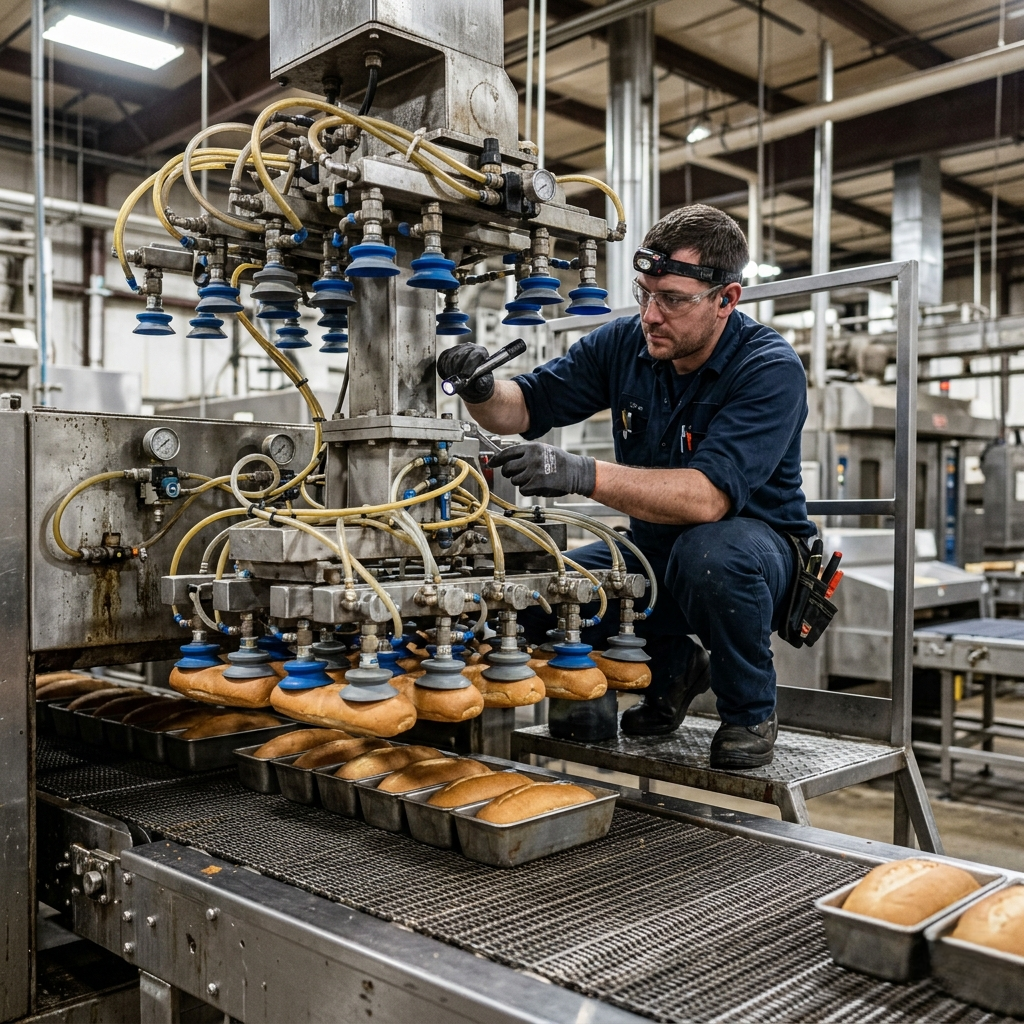
Product is dropping on the line, and your team is already compensating with manual adjustments just to keep things moving. Commercial depanner repair starts with a structured diagnostic sequence, and this guide walks through all four failure domains. Running the full sequence isolates the root cause and points to the right repair intervention every time.
Failure Domain One: Cup Condition in Commercial Depanner Repair
Cup condition is the first diagnostic domain in commercial depanner repair because cup degradation is the most common source of suction loss. The failure patterns are visible on inspection when you know what to look for.
What to Inspect on Cup Condition
- Contact face integrity is the first thing to check. The cup contact face should be smooth, uniform, and fully intact. Running a fingernail slowly across the surface reveals any flattening, edge curling, cracking, or irregularity that breaks the vacuum seal at the product contact point.
- Material compliance matters on soft cup formulations such as Soft Metal Det., Soft Translucent, and Blue Soft Metal. Press the cup face firmly against a hard surface and release. A soft cup that resists compression or rebounds with stiffness has lost its compliance through heat exposure or chemical softening and will perform like a worn standard cup.
- Wear distribution across the platen deserves a full inspection, covering all cup positions. Uneven wear creates an inconsistent vacuum hold, which is a system-level problem. Comparing cup condition across the full platen run gives a clearer picture before drawing any conclusions.
FBS carries the full vacuum cup inventory, including all types and sizes, detectable formulations, and custom parts for non-standard configurations.
Failure Domain Two: Retainer Integrity
Retainer integrity is the diagnostic domain most commonly skipped, and a cup in good condition mounted in a compromised retainer will produce the same suction loss symptoms as a worn cup. Checking the retainer is a required step in any commercial depanner repair sequence.
What to Inspect on Retainer Integrity
- Tension holding is tested by manually applying lateral pressure to each cup. A retainer that allows any cup movement has lost holding tension, and the intermittent nature of the suction loss under vacuum cycling is a reliable indicator. Rhythmic or production-cycling suction loss points to the retainer before cup condition.
- Retainer body condition should be assessed for visible deformation, cracking, or compression damage. A deformed retainer changes the cup’s seating angle relative to the product contact plane. The cup may be undamaged while the assembly as a whole is unable to hold the vacuum seal geometry.
- The inner diameter match between the retainer and the platen post is a specification check that resolves a common sourcing error. A retainer seated on the wrong post diameter allows cup movement under load, which appears as a mechanical failure. Confirming whether the retainer is 5/16″ or 3/8″ against the platen post spec is a fast, conclusive check.
- Detectable designation consistency should be verified on compliance-designated stations. Metal Retainer 026-001 and Blue Metal Retainer 026-002 are the correct detectable variants. White Retainer 026-000 is a non-detectable option that may have been substituted during a previous reactive repair and will surface as a compliance gap during an audit.
FBS carries the full retainer range across both inner diameter sizes and all material designations, including detectable variants.
Failure Domain Three: Belt System
Belt system failure can cause product inconsistency that may be misdiagnosed as cup or retainer failure. The product lifts correctly but releases or transfers incorrectly, and the diagnostic path runs through the belt system.
What to Inspect on the Belt System
- Belt surface condition is checked by inspecting the belt for wear, cracking, or surface irregularity. A belt that has lost surface integrity will cause placement errors or drops during transfer, even when the vacuum lift is functioning correctly. Product arriving inconsistently at the transfer point after a clean lift is the signal to move into this domain.
- Belt tension affects transfer performance in both directions. An over-tensioned belt accelerates wear on contact surfaces, and stresses drive components. An under-tensioned belt slips under the product load, and that slippage appears as a vacuum failure because the product moves unpredictably at the moment of release.
- Distinguishing belt failure from cup failure comes down to timing. A product that fails to lift from the pan or releases during the lift phase points to Domain One or Domain Two. Product lifting cleanly and dropping or misplacing on transfer points to the belt system.
FBS carries belt systems for commercial vacuum depanners.
Failure Domain Four: Residue Buildup
Residue buildup on cup contact surfaces reduces suction performance and can produce suction loss symptoms that are indistinguishable from cup wear. Ruling this out before initiating any component replacement saves both parts cost and diagnostic time in any commercial depanner repair situation.
What to Inspect for Residue Buildup
- Cup face contamination comes from baked product residue, cleaning chemicals, and environmental accumulation. A structurally intact cup seated correctly in a sound retainer can still fail to form a full vacuum seal when a contamination layer covers the contact face. Inspecting for discoloration, surface film, or tactile residue and cleaning thoroughly before ordering parts is the right sequence.
- Chemical degradation over time is a separate variable from surface residue. Repeated contact with aggressive cleaning chemicals softens cup material and accelerates compliance loss even when the cup face appears clean. Tracking replacement intervals against the cleaning protocol helps identify whether chemical exposure is the primary driver of a recurring failure pattern.
- Residue as a diagnostic reset point means that if vacuum performance recovers after cleaning, residue was the root cause, and no component replacement is needed. If performance does not recover, the cleaned cups and retainers can now be evaluated accurately in Domain One and Domain Two. Either way, cleaning first produces better diagnostic data.
Running the Full Diagnostic Sequence
Each failure domain produces a distinct signature. Constant suction loss across adjacent product positions points to cup condition first. Intermittent suction loss cycling with production points to retainer holding tension. Product lifting and dropping, or misplacing, at transfer points to the belt system. Suction loss that resolves after cleaning points to a buildup of residue.
The four-domain sequence isolates root cause and identifies the correct repair intervention, whether that is cup replacement, retainer replacement, belt service, or cleaning. Completing the sequence before ordering parts is the most efficient path through any commercial depanner repair job.
FBS carries vacuum cups, retainers, and belt systems for commercial depanner repair, covering all types and sizes, as well as custom parts for non-standard configurations. Call +1 (201) 437-0221 to confirm parts or schedule a certified technician visit.
Frequently Asked Questions
Can residue buildup on depanner cups cause vacuum loss?
Yes. Baked product residue, cleaning chemicals, and environmental contamination accumulate on cup contact faces and degrade the vacuum seal without damaging the cup structure. Cleaning the cup faces and retesting before diagnosing component replacement is the recommended first step.
How can a worn retainer be identified as the cause of suction loss?
Applying lateral pressure to each cup manually reveals any retainer that has lost holding tension. A cup that shifts or rocks on the post under that pressure will produce intermittent vacuum loss that cycles with production. Inspecting the retainer body for deformation or cracking confirms whether the seating angle has been compromised.
What is the difference between a 5/16″ and a 3/8″ depanner retainer?
The inner-diameter measurement refers to the platen post on which the retainer seats. A retainer placed on the wrong post diameter seats incorrectly and allows the cup to move under load. Confirming the inner diameter against the platen post specification before ordering replacement retainers prevents this sourcing error.
How can a belt problem be distinguished from a cup problem on a depanner?
The timing of the failure is the key indicator. A product failing to lift from the pan indicates cup condition and retainer integrity. Product lifting cleanly and dropping or misplacing during transfer points points to belt surface condition and tension.
Why do soft depanner cups fail even when they appear intact?
Soft cup formulations can lose compliance through heat exposure or repeated contact with cleaning chemicals. Pressing the cup face firmly against a hard, flat surface and releasing it reveals a loss of compliance as resistance or stiffness on rebound. A soft cup in that condition will perform like a worn standard cup regardless of appearance.
What are detectable retainers, and when are they required?
Detectable retainers contain metal-detectable material and are designated for compliance use on food safety-critical stations. FBS offers Metal Retainer 026-001 and Blue Metal Retainer 026-002 as detectable variants. White Retainer 026-000 is the non-detectable option and should be confirmed as the correct designation before use on compliance-designated stations.
How often should depanner cups be replaced?
Replacement interval depends on production volume, product type, pan geometry, cleaning protocol, and cup formulation. The correct indicator is inspection. A cup that fails the contact face and compliance checks in Domain One should be replaced regardless of time in service.
When should a certified technician be called for commercial depanner repair?
Specialist support is appropriate when the diagnostic sequence has isolated the failure domain, but the repair requires system-level adjustment. Recurring failures after component replacement, non-standard configurations, and persistent vacuum performance issues after completing the full sequence are all situations where a certified technician adds the most value. FBS can confirm parts specifications and schedule visits at +1 (201) 437-0221.