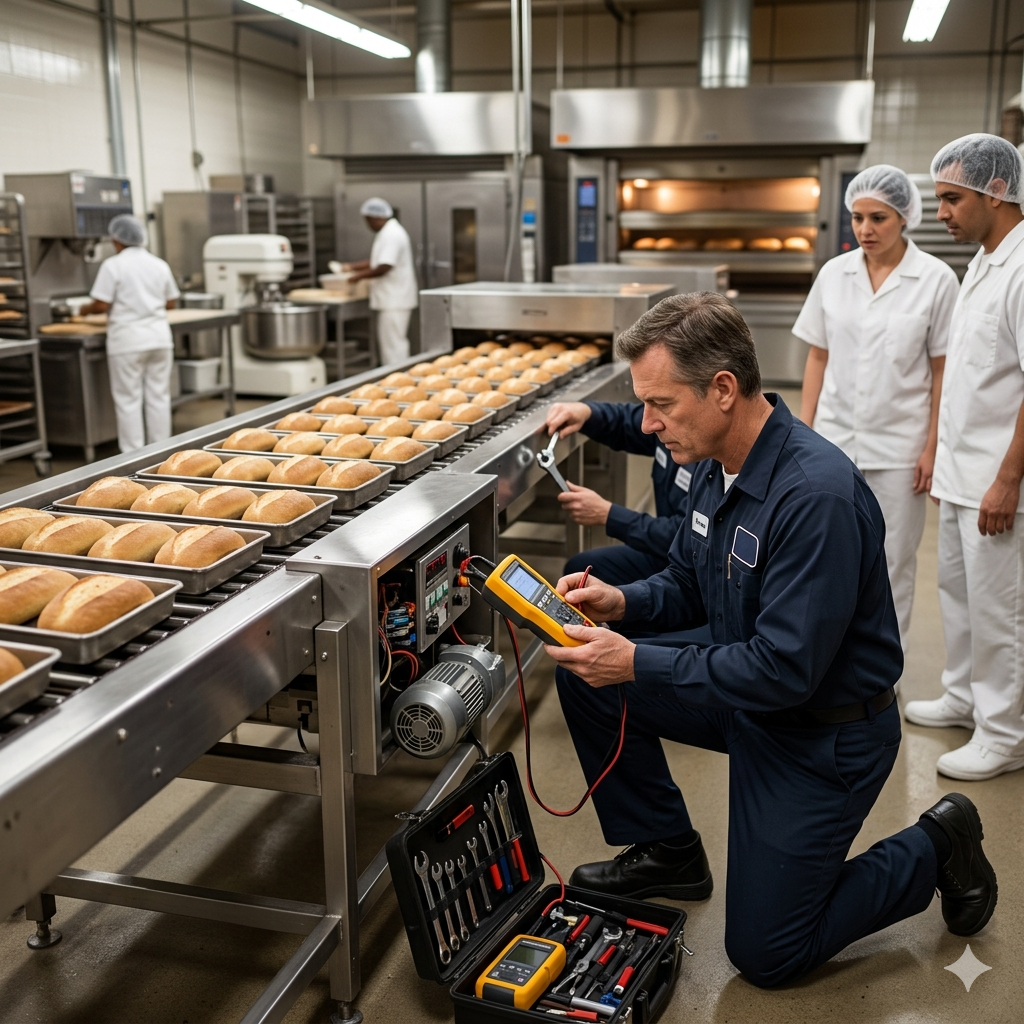
A bakery equipment repair service that covers proofers, coolers, and depanners under one partner is the fastest path through a multi-system breakdown. When a proofer goes down for a component failure while a cooler runs degraded, the repair calls are manageable on their own. A power surge, a production overload, or a deferred maintenance cascade can turn a recoverable event into a compounding crisis when three separate vendors, three scheduling timelines, and three parts lead times are involved with no single point of accountability.
Coordination Failure One: Sequential Scheduling That Repairs Systems in the Wrong Order
The most common coordination failure in multi-system bakery equipment repair service recovery is repairing systems in the order vendors become available, which restores production throughput most efficiently.
When separate vendors handle proofer repair and cooler repair, each schedules its visit independently. Neither vendor has visibility into the other system’s status, and neither coordinates timing around production recovery logic. The sequence gets built around vendor availability; when restored, it enables the next system to contribute to output.
The proofer was repaired and returned to operation, while the cooler continues to degrade, creating a throughput bottleneck. The repaired system generates output that the downstream system cannot handle. The repair was technically successful. The recovery sequence was wrong.
A single partner with certified technicians performing on-site service on proofers, coolers, and depanning equipment can sequence repair visits based on production recovery logic. Systems are restored in the order that returns meaningful throughput to the line, which is convenient for separate scheduling workflows.
Coordination Failure Two: Fragmented Parts Sourcing With No Cross-System Visibility
When separate vendors source parts independently for simultaneous repairs, each vendor optimizes for their own system, and the facility has no single visibility into which parts are arriving when, or which system’s recovery is at risk from a parts delay.
Three vendors sourcing parts across three systems means three separate lead times and three separate supplier relationships. A parts delay on the cooler, which extends the overall recovery timeline, may go unnoticed until the proofer repair is already complete and the cooler is still waiting. By the time the constraint becomes visible, the recovery window has narrowed.
A single bakery equipment repair service partner with deep cross-system parts inventory covering 8,000 plus replacement parts across proofer trays and accessories, cooler trays and spare parts, and vacuum depanner cups and retainers provides single-source visibility across the full recovery. Parts availability for all three systems is confirmed in one conversation.
For facilities running non-standard or legacy components, custom parts made to specification are available across all system categories, eliminating the sourcing gap that pushes operators toward multi-vendor arrangements.
Coordination Failure Three: Accountability That Ends at the System Boundary
In a multi-vendor repair architecture, each vendor’s accountability ends at the boundary of their assigned system, and problems at system interfaces have no owner.
Commercial bakery production systems operate as an interdependent sequence. A repair to the proofer that overlooks the operational state of the cooler or depanner can create interface problems such as throughput mismatches, timing inconsistencies, or component interactions that fall outside any individual vendor’s contracted scope. When that interface problem surfaces, each vendor correctly identifies it as outside their responsibility. The facility owns the gap, and resolving it means restarting the coordination process.
A single partner covering proofers, coolers, and depanning equipment owns both the interface and the system. A certified technician who understands how all three systems interact in a production sequence can identify and address interface issues during recovery, without requiring a new service call.
Coordination Failure Four: Legacy Platform Expertise Isolated From the Rest of the Recovery
Facilities running Latendorf, BEW, or Baker Perkins traveling-tray proofers and coolers face a compounded coordination problem in multi-system recovery. The specialist knowledge required for those platforms is rare, which typically forces a two-tier vendor architecture with one specialist for legacy systems, generalists for everything else, and no coordination between them.
When the legacy system specialist and the generalist service vendor are separate entities, the coordination failures identified in the first three sections are built into the vendor relationship. The recovery sequence is fragmented. Parts sourcing is fragmented. Accountability is fragmented. The two-tier structure institutionalizes the multi-system coordination problem.
FBS was founded in 1990 following the closure of Latendorf Conveying Corporation, and has established institutional platform knowledge carried forward through 40-plus years of traveling tray proofer and cooler service. That legacy expertise is part of the same service relationship as proofer, cooler, and depanner coverage, running alongside it.
A single bakery equipment repair service partner who combines legacy Latendorf, BEW, and Baker Perkins platform expertise with full coverage of proofers, coolers, and depanners brings specialist knowledge and system breadth into one relationship.
The Architecture Is the Variable
Multi-system recovery managed through fragmented vendors fails because the coordination architecture was built for single-system events. Separate vendors produce sequential scheduling errors, invisible parts constraints, unowned system interfaces, and isolated legacy expertise. Each of these extends the recovery independently, and all of them compound when they occur together.
A single bakery equipment repair service partner covering proofers, coolers, and depanners, with deep parts inventory, legacy platform expertise, and accountability across system interfaces, is the architecture that makes multi-system recovery orderly.
FBS provides bakery equipment repair service across proofers, coolers, and depanners, including legacy Latendorf, BEW, and Baker Perkins systems, through a single point of contact. Call +1 (201) 437-0221 to discuss whether your current vendor structure is ready for a multi-system event.
Frequently Asked Questions
What is a bakery equipment repair service partner?
A bakery equipment repair service partner is a single vendor that provides technical service, parts sourcing, and on-site repair across multiple production systems, including proofers, coolers, and depanners, under a single point of accountability. The distinction matters most during multi-system breakdown events, when fragmented vendor relationships lead to coordination failures that extend recovery timelines.
Why does multi-system bakery equipment repair require a different vendor approach?
When multiple production systems require repair simultaneously, the coordination layer covering scheduling, parts sourcing, and accountability across system interfaces becomes the primary recovery variable. A single vendor managing all affected systems can sequence repairs around production throughput logic, while separate vendors each optimize for their own system with no visibility into the others.
How should multi-system bakery equipment repairs be sequenced for the fastest production recovery?
Repairs should be sequenced based on which system’s restoration enables the next system to contribute to production output. A single bakery equipment repair service partner covering all affected systems can apply that sequencing logic across the full recovery from the start.
How does parts inventory depth affect multi-system bakery equipment recovery time?
A service partner with deep cross-system parts inventory provides single-source visibility into what is available, when it arrives, and which system’s recovery is most parts-constrained. Without that visibility, parts delays in one system can extend the overall recovery timeline, only surfacing after another system’s repair is already complete.
Who is responsible for fixing problems between bakery equipment systems during a repair?
In a multi-vendor repair architecture, no one owns the interface between systems, and each vendor’s accountability ends at the boundary of their assigned system. A single bakery equipment repair service partner covering all three system categories takes accountability for interface issues as part of the recovery.
Who provides repair service for legacy Latendorf, BEW, and Baker Perkins equipment?
FBS provides specialized repair services for Latendorf, BEW, and Baker Perkins traveling tray proofers and coolers, drawing on institutional expertise dating to FBS’s founding in 1990 following Latendorf Conveying Corporation’s closure. That legacy platform knowledge is available within the same service relationship as full proofer, cooler, and depanner coverage.
What parts are available for commercial bakery proofer and cooler repairs?
FBS maintains an inventory of 8,000 plus replacement parts covering proofer trays and accessories, cooler trays and spare parts, and vacuum depanner cups and retainers across all types and sizes. Custom parts made to specification are also available for non-standard and legacy system components, eliminating the sourcing gaps that typically require multi-vendor approaches.
What is a traveling tray proofer, and who services them?
A traveling tray proofer is a conveyor-based proofing system that moves dough through a controlled environment on continuous trays, common in high-volume commercial bakery production. Legacy platforms, including Latendorf, BEW, and Baker Perkins, require specialist knowledge that is rare in the general service market, and FBS has provided traveling tray proofer repair services for 40+ years.
Can a single bakery equipment repair service cover proofers, coolers, and depanners?
Yes. FBS provides on-site repair service across all three system categories, including proofers, coolers, and vacuum depanners, with certified technicians, deep parts inventory, and legacy platform expertise under a single point of contact. That coverage eliminates the coordination failures that occur when separate vendors manage simultaneous repairs across multiple systems.
What causes multi-system bakery equipment failures?
Common root-cause events for multi-system failures include power surges, production overloads, and deferred maintenance cascades, all of which can affect multiple systems simultaneously. The recovery complexity in these events is driven less by the technical severity of the failures and more by the architecture used to coordinate repairs.