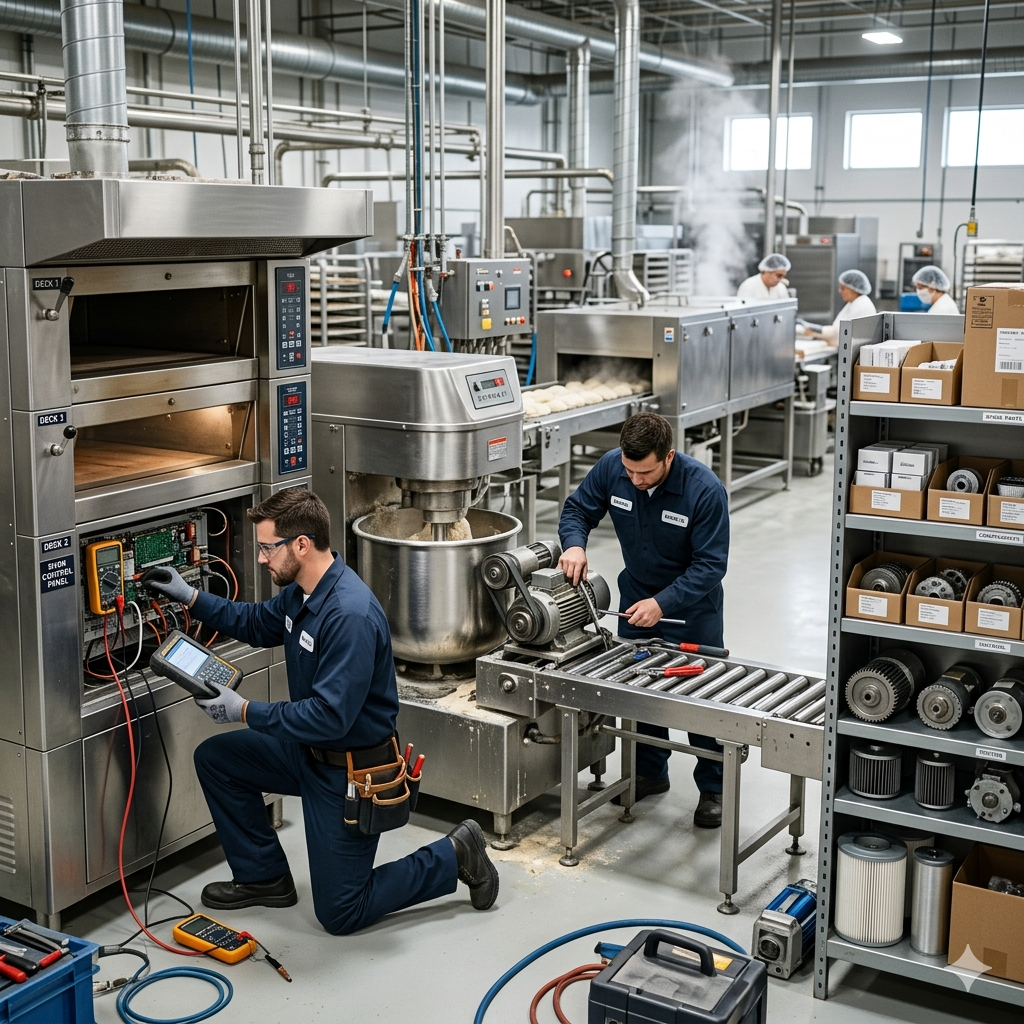
Bakery operations are supported through coordinated service systems where parts, supply maintenance, and equipment support are managed under a unified structure. Rely on FBS for consistent, dependable support that ensures organized maintenance and timely technical response across equipment needs, giving operators peace of mind.
Service delivery is guided through planned diagnostics, routine maintenance, and prepared component availability. Technicians conduct structured evaluations of ovens, mixers, and proofers to ensure consistent equipment performance. Operational continuity is supported through organized service cycles and scheduled technical attention.
More Than a Catalog
A big parts catalog and true parts depth are two different things. The gap shows up the moment an operator needs something outside the standard range. A flat-profile vacuum depanner cup, a retainer in a specific inner diameter, or a proofer tray accessory that has been out of standard production for years.
Real depth means carrying inventory across every major equipment category a facility runs. That includes vacuum depanner cups in all types, standard, soft, metal detectable, and flat profile retainers in both inner diameter sizes, proofer trays and accessories, cooler trays and spare parts, and the ability to produce custom components to specification when a part cannot be sourced through normal channels. FBS maintains an inventory of 8,000-plus replacement parts built specifically to serve facilities running multiple equipment categories from a single supplier.
A useful question to ask a current parts supplier: can they fulfill one order that covers depanner, proofer, and cooler needs, including a non-standard component? If that requires a callback, a second vendor, or an extended lead time, the inventory falls short of full-service.
On-Site Service: The Capability that Separates Suppliers from Service Providers
Shipping parts is one thing. Sending a certified technician to the facility is another. That distinction separates a parts supplier from a provider of genuine commercial bakery services.
A full-service provider dispatches certified technicians for installation, repair, inspections, and scheduled maintenance. On-site visits allow technicians to identify wear patterns, flag at-risk components, and gain insights into overall equipment health that remote diagnostics cannot provide, leading to better operational intelligence and fewer unexpected breakdowns.
What On-Site Service Should Cover
A qualified technician assesses more than the immediate repair. The surrounding system gets reviewed. Findings get documented. Secondary failure risks get flagged before they become production stops. A service vendor that addresses only the component that prompted the call is providing reactive service, a limited form of full-service support.
The useful question here is: when a call goes to the service vendor, does a technician come to the facility, or does the conversation stay on the phone?
Specialized Equipment Knowledge: Generalist Service Has a Ceiling
A generalist technician can identify a mechanical failure. A specialist knows the failure patterns, the parts history, the design logic of a specific equipment generation, and which components are most likely to fail next. For bakeries running legacy systems, traveling tray proofers, and coolers from Latendorf, BEW, or Baker Perkins, that knowledge gap has real consequences.
FBS was founded in 1990, following the closure of Latendorf Conveying Corporation. The institutional knowledge of those systems was transferred directly into FBS’s technical foundation. That history is the source of specialized depth that generalist vendors cannot develop without extended exposure to the same platforms. Knowing a Latendorf or Baker Perkins system means understanding its failure modes, its limits on parts interchangeability, and the design decisions that shape its maintenance.
The useful question: Does the service vendor know the specific equipment platform before arriving, or does the learning happen on-site?
Maintenance Support: Scheduled Service Keeps Lines Running
There is a meaningful difference between a vendor who shows up after a failure and one who helps prevent failures. Full-service bakery support includes routine inspections and preventive maintenance, performed on your schedule to keep your operation running smoothly and demonstrate our commitment to your success.
Scheduled maintenance capability allows a service provider to be built into a facility’s PM program. That means regular inspections, preventive parts replacement, and equipment-wide assessments conducted by a technician who builds familiarity with that facility’s equipment over time. The vendor accumulates knowledge. They know what was replaced last quarter, what was flagged as at-risk, and what to prioritize on the next visit.
FBS offers maintenance plans structured to fit each facility’s operational requirements, including certified technician inspections on a defined schedule. A service provider who works within a maintenance calendar becomes a partner in uptime. One who only responds to calls stays in the reactive column.
The useful question: can the current vendor work within an existing maintenance schedule, or do they appear only when called?
Availability: Full-Service Means Available When It Matters
Every capability described above becomes useful only when the vendor is reachable at the moment the equipment fails. With FBS operating 24/7, you can count on immediate support during any shift, even at 2 AM, ensuring your operation is never left vulnerable.
A parts supplier with deep inventory and no after-hours contact serves daytime operations well and night-shift failures poorly. A service vendor whose technicians are unreachable during off-hours is a business-hours resource. Neither meets the standard of genuine commercial bakery services.
FBS operates around the clock, providing 24/7 on-call support so that assistance is available whenever equipment fails, even during late-night or early-morning hours. This ensures that your bakery can quickly recover from unexpected breakdowns, minimizing production delays and maintaining customer satisfaction.
The useful question: if the line went down at 2 AM, could the service vendor be reached, and would a qualified technician be able to respond?
What Full-Service Commercial Bakery Services Actually Require
The five dimensions covered here are parts depth, on-site service, specialized equipment knowledge, scheduled maintenance, and 24/7 availability, which define what a full-service provider should deliver. An operator working with a vendor who covers all five eliminates the coordination overhead and coverage gaps that come with fragmented sourcing.
FBS serves as a single point of contact for parts, service, maintenance, and specialized equipment support across the NJ/NY/PA tri-state area. All five dimensions are covered.
Call +1 (201) 437-0221 to discuss the full scope of your operation and whether your current vendor is delivering across every area that matters.
Frequently Asked Questions
What does a full-service commercial bakery services provider include?
A full-service provider covers five areas: parts inventory across all major equipment categories, on-site technician dispatch, specialized knowledge of legacy equipment platforms, scheduled maintenance support, and 24/7 on-call availability. Operators with fragmented sourcing across multiple vendors often face coverage gaps when failures cross vendor boundaries. A single provider covering all five areas eliminates that exposure.
What should a commercial bakery parts supplier stock?
A qualified parts supplier carries inventory across all major equipment categories, including vacuum depanner cups in all types, proofer and cooler trays and accessories, and retainers in standard inner diameter sizes. The supplier should also be able to manufacture or source custom components for non-standard or legacy parts. An inventory limited to high-turnover items leaves operators without support for specialty or older equipment.
Do commercial bakery service companies send technicians on-site?
Full-service commercial bakery services companies dispatch certified technicians directly to the facility for installation, repair, inspection, and maintenance. On-site visits also allow technicians to conduct equipment appraisals, identifying wear patterns and at-risk components before they cause production failures. A service vendor limited to phone diagnostics or parts shipments provides a narrower level of support.
Who specializes in Latendorf and Baker Perkins commercial bakery equipment service?
FBS was founded in 1990, following the closure of Latendorf Conveying Corporation, giving the company direct institutional knowledge of Latendorf traveling tray systems and related legacy equipment from Baker Perkins and BEW. Generalist service vendors typically learn legacy platforms on-site, which increases diagnostic time and raises the risk of misidentified failure modes. Operators running legacy proofers and coolers benefit from a service provider whose technical knowledge matches the equipment’s service history.
Can a commercial bakery service company provide scheduled maintenance?
A full-service commercial bakery services company can integrate into a facility’s preventive maintenance program, performing scheduled inspections, preventive parts replacement, and equipment assessments on a defined calendar. This differs from reactive service, where the vendor responds only after a failure occurs. A vendor participating in scheduled maintenance accumulates facility-specific knowledge over time, which improves every subsequent service visit.
Are commercial bakery service companies available 24/7?
Full-service providers operate on a 24/7 on-call basis because equipment failures occur across all shifts. A vendor without after-hours availability functions as a daytime resource, unreachable during the production windows where failures are most costly. When evaluating a service vendor, confirm that a qualified technician is reachable and able to respond at any hour.
What is the difference between a parts supplier and a full-service bakery equipment provider?
A parts supplier fulfills component orders. A full-service bakery equipment provider also dispatches technicians, performs maintenance, and supports the operator across the equipment lifecycle. The practical gap appears when equipment fails, and the parts supplier has no service capability, or when a service vendor cannot source the required component. A full-service provider covers both under one point of contact.
Why Does Fragmented Vendor Sourcing Create Problems For Commercial Bakeries?
When parts, service, and specialized equipment support come from separate vendors, accountability gaps arise where their scopes of work overlap poorly. This is especially true when a failure involves a cross-system issue or a component that one vendor stocks but another vendor needs to install. A single full-service commercial bakery services provider covers all capability dimensions under one contact, removing those gaps entirely.